Runway Media Router launches to pick AI media models by cost and quality
Runway’s new developer tool routes image, video and audio requests across AI models as generative media competition intensifies.
By Theo Nakamura · Staff Writer
· 3 min read
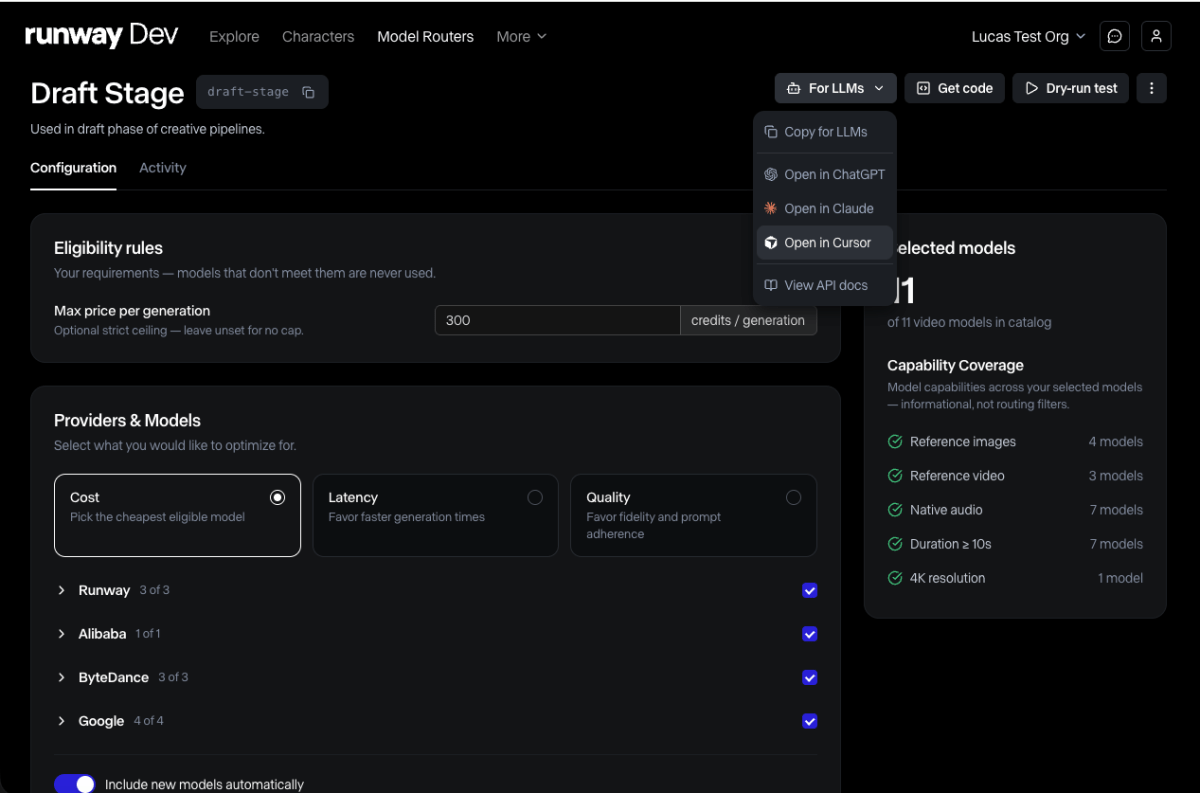
Runway Media Router launched Thursday, giving developers a way to send AI image, video and audio requests to whichever model best fits their needs. For investors watching the AI buildout, the move shows Runway trying to compete less as a single-model winner and more as infrastructure for companies adding generative media to their own products.
The router is available through Runway Dev, the company’s developer platform released earlier this month. Runway Dev offers API access to Runway’s own models as well as a growing set of third-party media models. An API, or application programming interface, lets software systems talk to each other so a company can add Runway-powered media tools without sending users to Runway’s app.
What is Runway Media Router?
Runway Media Router is software that chooses among generative media models based on priorities a developer sets, such as output quality, response speed or cost. Runway says model routing is already common for large language models, the text-focused AI systems behind chatbots, but says its product is the first router built specifically for generative media.
Anthony Maggio, Runway’s chief product officer, told TechCrunch the product is meant to make Runway Dev a single place for developers to connect with media-generation models. He said many developers do not have time to compare every new model release across video, image and audio, especially as the number of options grows.
Runway says customers using Runway Dev include Adobe, Cloudflare, ElevenLabs, Expedia, Shutterstock and Quora. Those companies can build media generation into their own products using Runway’s API rather than directing customers to Runway’s consumer-facing tools.
Why routing matters as AI media gets crowded
The pitch is straightforward: the “best” model may change depending on the job. A video model that handles motion well may not be the right choice for an image task focused on composition, while an audio model may need to be judged on voice quality or lip syncing. Maggio told TechCrunch Runway’s routing layer uses knowledge from the company’s internal creative team, which evaluates model output across different media types.
Cost is also part of the product. Maggio said customers are especially interested in routing based on token pricing and quality. Token pricing means users pay based on units of AI usage rather than a flat unlimited plan. TechCrunch noted that token costs have become a bigger issue in 2026 for companies using agentic AI systems, and Runway recently replaced unlimited subscription plans with token-based pricing, a change that drew criticism from some users.
Developers may also set other preferences. Maggio said Chinese generative media models are gaining popularity, but some businesses may be uncomfortable relying on models from China. He said those companies could potentially prefer American model providers, especially as the Trump administration explores bans and sanctions related to Chinese open AI models.
Runway’s broader shift
The launch fits a larger change at Runway. The company built its reputation around AI video tools, but it is now pushing deeper into the infrastructure stack behind generative media. Runway released Gen 4.5 in December, when CNBC reported that the model beat similar offerings from companies including Google. Runway also released its first world model that month.
Since then, TechCrunch reported, Runway has updated its video editing model Aleph 2.0, but has not released a new dedicated frontier video model in months. Artificial Analysis ranks Aleph 2.0 among top video editing models, while Runway’s text-to-video and image-to-video models no longer lead its rankings. Models from Google, ByteDance and Alibaba appear in the top 20, according to TechCrunch.
Anastasis Germanidis, Runway’s co-founder and co-CEO, told TechCrunch that Runway has long been known for its end-user product, but had to build a broader stack underneath it, including a developer platform, creative tools and an inference layer. He said orchestration has become more important as companies build full campaigns and multi-scene outputs with generative media models.
This story draws on original reporting from TechCrunch.