Heavy truck sales fell 32.5% year over year in December
Calculated Risk, citing BEA data, said heavy truck sales ended 2025 at a sharply lower annualized pace after weakening in the fourth quarter.
By Priya Nair · Economy Reporter
· 2 min read
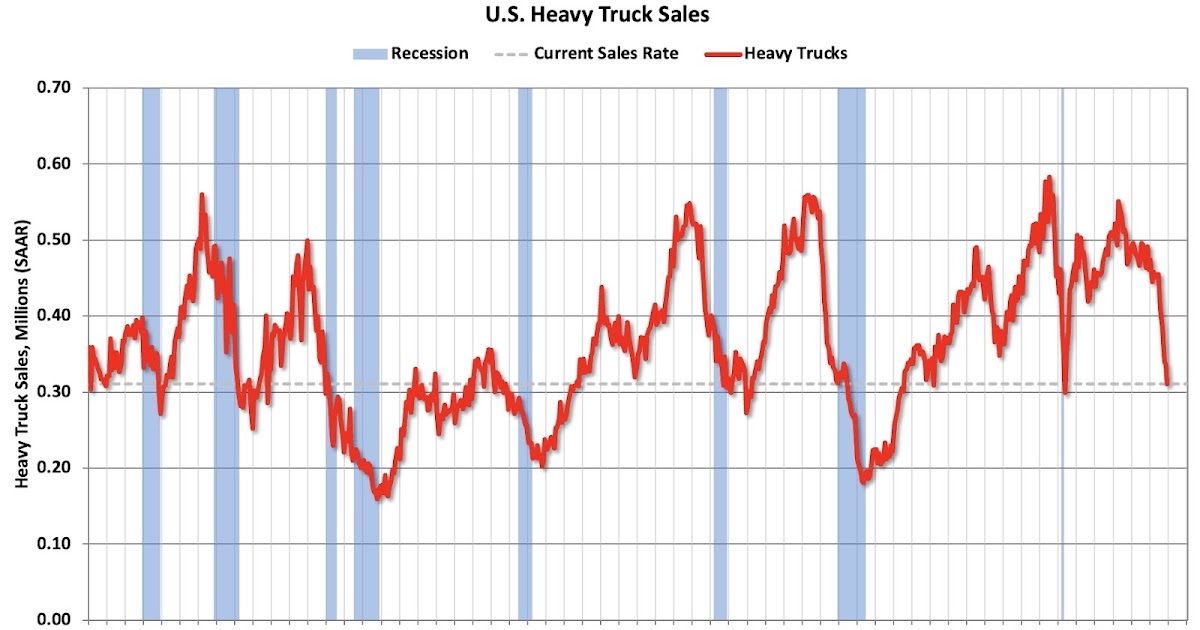
Heavy truck sales dropped sharply in December, a data point that matters because this category has often weakened before recessions, according to Calculated Risk. For everyday investors, the move is another macro signal to watch alongside jobs, housing and consumer spending, since it points to softer demand in a cyclical part of the economy.
Calculated Risk, citing data from the Bureau of Economic Analysis, reported that heavy truck sales ran at a seasonally adjusted annual rate of 311,000 in December 2025. That was down from 336,000 in November and 32.5% below the 461,000 rate recorded in December 2024.
A seasonally adjusted annual rate, or SAAR, converts a monthly pace into an annualized figure while adjusting for regular calendar patterns. In plain English, it asks: if the month’s adjusted sales pace continued for a full year, how many units would be sold?
The category covers heavy trucks with a gross vehicle weight of more than 14,000 pounds, according to the definition cited by Calculated Risk. Gross vehicle weight refers to the maximum loaded weight of the vehicle, including the truck itself and what it carries.
2025 ended well below 2024
The December decline capped a weak year for the category. Calculated Risk said heavy truck sales for all of 2025 were 15.3% lower than annual sales in 2024.
The monthly step down was also notable. December’s 311,000 SAAR was 25,000 below November’s 336,000 pace, based on the figures reported by Calculated Risk. Compared with the same month a year earlier, the annualized rate was lower by 150,000.
Calculated Risk’s chart tracks heavy truck sales back to 1967 using BEA data. The December 2025 reading was marked at 311,000 SAAR on that long-running series.
Why investors watch this number
Calculated Risk noted that heavy truck sales usually fall sharply ahead of recessions and said sales have dropped recently. That does not mean one indicator can call the economy by itself. It does mean the series can add context when investors are weighing broader economic risk.
Heavy truck sales are a narrow slice of the economy, so the number should be read with other indicators. Still, a year-over-year drop of 32.5% in December and a 15.3% decline for 2025 point to a clear pullback in this specific market, based on the BEA data cited by Calculated Risk.
The next readings will show whether December was part of a continuing downtrend or whether sales stabilize after the fourth-quarter weakness. For now, the latest available figures show heavy truck demand ending 2025 at a much lower pace than a year earlier.
This story draws on original reporting from Calculated Risk.