AI spending and inflation frame a new bear case for stocks
A Wealth of Common Sense says strong earnings support the bull market, but AI capex, retail speculation and high rates could test the rally.
By Sofia Marchetti · Columnist
· 4 min read
Stocks have been rising on stronger earnings, high profit margins and broader market leadership, according to A Wealth of Common Sense. The same post argues investors should still pay attention to the bear case, because several risks now sit close to the center of the market story.
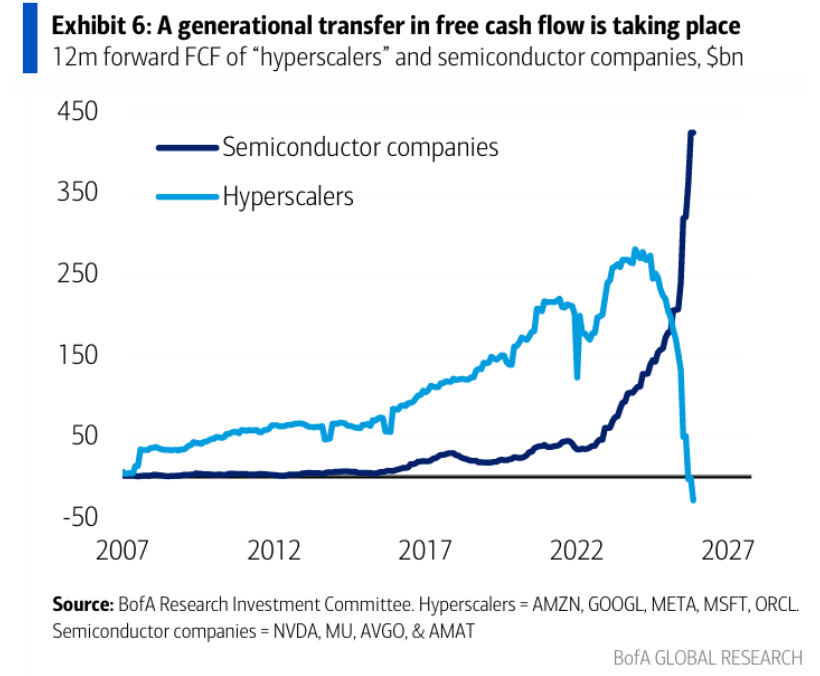
The first concern is artificial intelligence spending. A Wealth of Common Sense pointed to falling free cash flow at large cloud and technology companies known as hyperscalers, while semiconductor companies collect more of the money being spent on AI infrastructure. Free cash flow is the cash a company has left after paying for operations and investments, and falling cash generation can make big spending plans harder to sustain.
That matters because AI capital expenditures, or capex, have become a major driver of earnings expectations. Capex means money companies spend on long-term assets such as data centers, chips and computing equipment. If that spending slows before demand from customers outside the biggest tech companies arrives, the post argues, the market could lose one of its main growth engines.
A second risk comes from the Magnificent Seven, the mega-cap technology stocks that still account for roughly one-third of the S&P 500, according to A Wealth of Common Sense. The post said every stock in that group except Apple is in a double-digit decline from its highs, even as leadership has expanded to other parts of the market.
Broader leadership can be healthy for an index, because gains are less dependent on a small set of companies. But the post argues that if the largest tech stocks fall more sharply, their weight in the S&P 500 means the broader index would likely feel it.
AI’s role may also extend beyond stocks. A Wealth of Common Sense cited charts from Michael Cembalest of J.P. Morgan showing AI’s effect on the economy, and argued that a slowdown in AI investment could contribute to a wider economic slowdown.
Retail investor activity is another warning sign in the post. Citadel Securities said retail investors are deploying capital at a record pace, with participation across IPOs, options, futures, leveraged ETFs and stocks. Options and futures are contracts tied to the future price of an asset, while leveraged ETFs use borrowing or derivatives to magnify daily moves. Those products can increase gains, but they can also amplify losses.
The macro backdrop adds more pressure. A Wealth of Common Sense said the Iran war has pushed inflation back above 4%, and argued that persistent inflation would be a headwind for the economy. Higher inflation tends to keep interest rates elevated, and the post noted that the 30-year fixed mortgage rate is close to 7% again.
Housing is a major part of the U.S. economy, and high mortgage rates can make homes less affordable, slow transactions and pressure related industries. A Wealth of Common Sense said the housing downturn has not yet caused major damage, while questioning how long that can continue.
The post also pointed to market psychology. The S&P 500 rose 10% in the first half of this year after gaining 18% in 2025, 25% in 2024 and 26% in 2023, according to A Wealth of Common Sense. The concern is that long periods of calm can encourage more risk-taking, sometimes described as a Minsky moment when stability eventually gives way to instability.
Other bear-case arguments in the post include the possibility that AI has bubble characteristics, a long stretch since what it calls the last true U.S. recession, and unusually strong returns from recent market lows. A Wealth of Common Sense said the S&P 500 is up nearly 24% annualized from the 2022 bear-market bottom and 23% per year from the late-March 2020 Covid lows.
The post’s bottom line is not that a downturn is certain. It presents the bearish case as a counterweight to bullish indicators, with the market’s next move dependent on whether earnings strength and broader participation can outweigh AI concentration, inflation, rates and investor enthusiasm.
This story draws on original reporting from A Wealth of Common Sense.