Agility Robotics opens Fremont robot training site as Tesla readies Optimus
Agility’s new 60,000-square-foot facility will train Digit robots for warehouse and factory work as the company heads toward public markets.
By Jordan Bell · Startups & Deals Reporter
· 3 min read
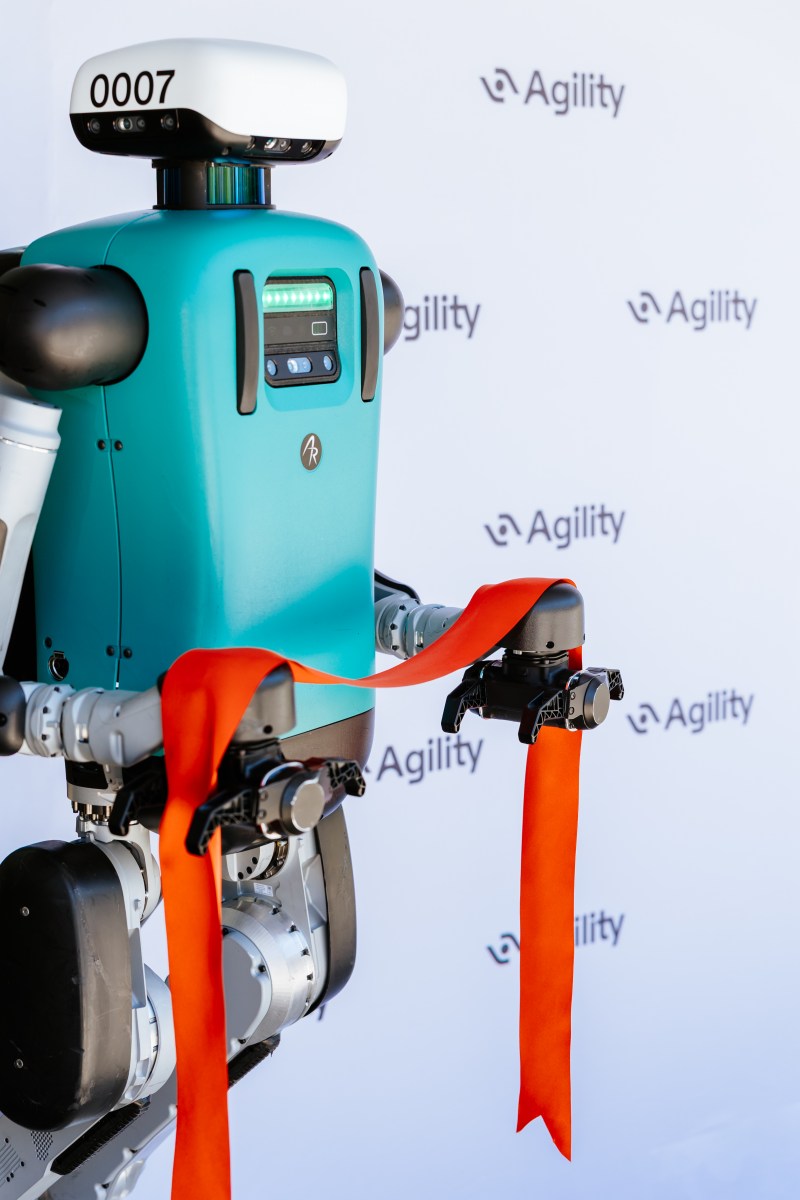
Agility Robotics is expanding in Fremont, California, with a 60,000-square-foot training facility for its Digit humanoid robots, putting the company near Tesla’s expected production site for Optimus. For investors tracking the robotics race, the contrast is straightforward: Tesla has scale and capital, while Agility says its robots are already doing paid work.
The new site is meant to speed up customer deployments by letting Digit practice tasks in settings similar to warehouses and factories. Digit is a six-foot-tall, two-legged robot built for industrial jobs such as moving totes and bins, a common logistics task that still requires a lot of human labor.
Agility CEO Peggy Johnson told TechCrunch that more than 30 customers are discussing Digit deployments with the company. Agility says it has secured $300 million in contract orders for its robots, and its named customers include Amazon, GXO, Schaeffler and Toyota Motor Manufacturing Canada.
The company has not said how many Digit robots it has built or placed with customers. TechCrunch reported that outside observers estimate dozens have been used in pilot programs or revenue-producing deployments. Agility has also said Digit robots moved 100,000 totes at a GXO logistics facility.
Why Fremont is a pointed choice
Agility’s facility sits up the highway from Tesla’s factory, where Tesla is expected to begin making Optimus robots this year, according to TechCrunch. Tesla CEO Elon Musk recently said he expects Optimus to become “the biggest product ever” once it is “useful outside of Tesla sometime next year.”
Johnson framed Tesla’s nearby presence as helpful for the broader humanoid robot category. She told TechCrunch it is “great” to have Tesla in the same area because Agility had been largely alone in the field for years.
Her pitch is that Agility has already moved from lab demos into industrial operations. Johnson said the company has learned how to meet customer safety, regulatory and compliance requirements, and how to connect with warehouse management systems, the software companies use to track inventory and work inside logistics facilities.
That operating experience could matter as Agility pursues a reverse merger expected to take it public later this year, according to TechCrunch. A reverse merger is a route to the stock market in which a private company combines with an already public entity, rather than using a traditional initial public offering.
Agility is keeping AI away from the safety layer
Agility was founded in 2015 by researchers working on techniques for safe two-legged walking. The company is now competing with a newer group of humanoid robotics startups, including Figure, 1X, the Bot Company and Sunday Robotics.
Artificial intelligence is part of the story, but Agility’s leaders are drawing a line around safety. Co-founder and chairman Damion Shelton told TechCrunch that safety systems should not run through generative AI, the type of AI that creates text, images or actions from patterns in training data. “You don’t want to get creative with your safety stack,” Shelton said.
Shelton said generative AI can help solve a different problem: scale. There are far more possible robot tasks than engineers available to manually program each one, he told TechCrunch.
Agility is also staying focused on industrial work rather than home robots. Digit currently works in areas without humans, but version 5, expected this fall, will be able to detect people and will not need to remain in a robot-only zone, according to TechCrunch.
Co-founder and chief robot officer Jonathan Hurst told TechCrunch that manufacturing and logistics alone offer plenty of work, starting with bins and totes before moving into harder jobs such as picking, kitting, cardboard handling and loading trailers.
This story draws on original reporting from TechCrunch.