SK Hynix raises $26.5 billion in record US market debut
The South Korean memory-chip maker’s Nasdaq listing topped Alibaba’s 2014 IPO as AI demand keeps reshaping semiconductor markets.
By Jordan Bell · Startups & Deals Reporter
· 3 min read
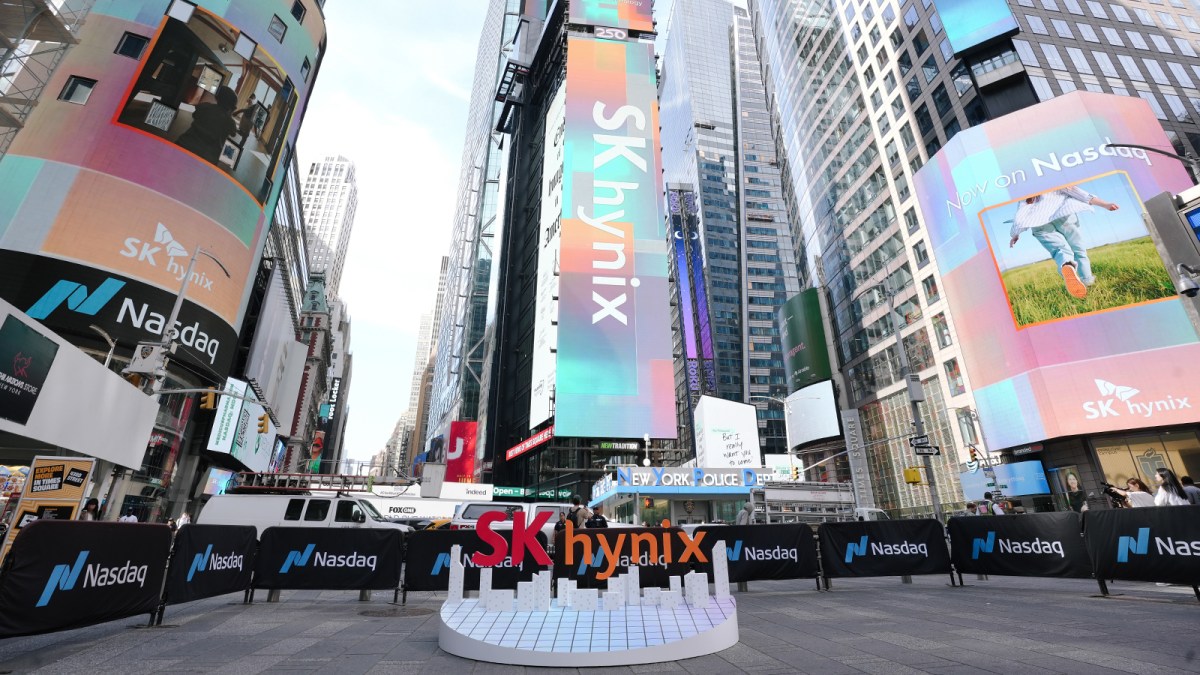
SK Hynix raised $26.5 billion, or KRW 40 trillion, in its U.S. market debut, the South Korean memory-chip maker said Friday. For retail investors watching the AI buildout, the deal puts another major supplier to Nvidia-linked infrastructure directly in front of U.S. public-market buyers.
The company sold 177.9 million American depositary shares at $149 each, according to SK Hynix. American depositary shares are U.S.-traded securities that represent shares of a foreign company, giving investors a way to buy exposure without trading on the company’s home exchange.
TechCrunch reported that the structure lets U.S. investors buy in at about one-tenth of the price of a full share in Seoul. The offering is the largest U.S. debut by a non-U.S. company, surpassing Alibaba’s $25 billion initial public offering in 2014, according to TechCrunch and Alibaba’s SEC filing.
SK Hynix began trading Friday, July 10, on Nasdaq under the temporary ticker SKHYV. The company’s regular trading ticker is scheduled to change to SKHY on Monday, July 13. Yahoo Finance data cited by TechCrunch showed the stock opened 14% above its offering price and continued to rise in early Friday trading.
The deal priced at a 2.7% premium to SK Hynix’s three-day average share price in Seoul, according to the company’s Korea Stock Exchange filing cited by TechCrunch. Bloomberg reported that demand for the offering was more than seven times the number of available shares.
AI memory demand is the center of the story
SK Hynix makes memory chips, including high-bandwidth memory, or HBM. HBM is a faster type of memory used alongside advanced AI graphics processors, which need to move large amounts of data quickly while training and running AI models.
TechCrunch reported that Nvidia counts SK Hynix as one of its main suppliers. That connection helps explain why investors treated the listing as a direct way to get exposure to the AI chip supply chain, beyond the companies that design processors.
According to SK Hynix’s filing cited by TechCrunch, the company plans to use the offering proceeds for three areas: a new fabrication plant in South Korea, a domestic packaging facility and extreme ultraviolet, or EUV, scanners. EUV scanners are chipmaking machines used to produce more advanced semiconductors.
The new South Korean fab is already under construction and is aimed at addressing a global memory shortage tied to AI demand, according to the filing cited by TechCrunch. Packaging, meanwhile, refers to the process of assembling chips so they can be connected efficiently inside computing systems.
Washington wants more memory production in the U.S.
The listing landed as U.S. officials pressed chipmakers to expand domestic manufacturing. Bloomberg reported that U.S. Commerce Secretary Howard Lutnick said at a Micron event Thursday that he was in talks with Samsung and SK Hynix about building new U.S. factories.
Micron, one of SK Hynix’s major competitors, has already announced plans to invest $250 billion in U.S. manufacturing. The U.S. memory-chip maker said the plan would create more than 90,000 jobs and keep leading-edge chip production in the United States.
The timing adds a political layer to SK Hynix’s Wall Street debut. TechCrunch reported that Samsung and SK Hynix recently pledged more than $550 billion for new manufacturing investment in South Korea, even as U.S. officials are seeking more memory capacity on American soil.
This story draws on original reporting from TechCrunch.