Trump split MMR vaccine plan faces long path to market
Trump’s order recommends separate MMR shots, but experts say new vaccines would take years to develop and could add barriers for families.
By Theo Nakamura · Staff Writer
· 3 min read
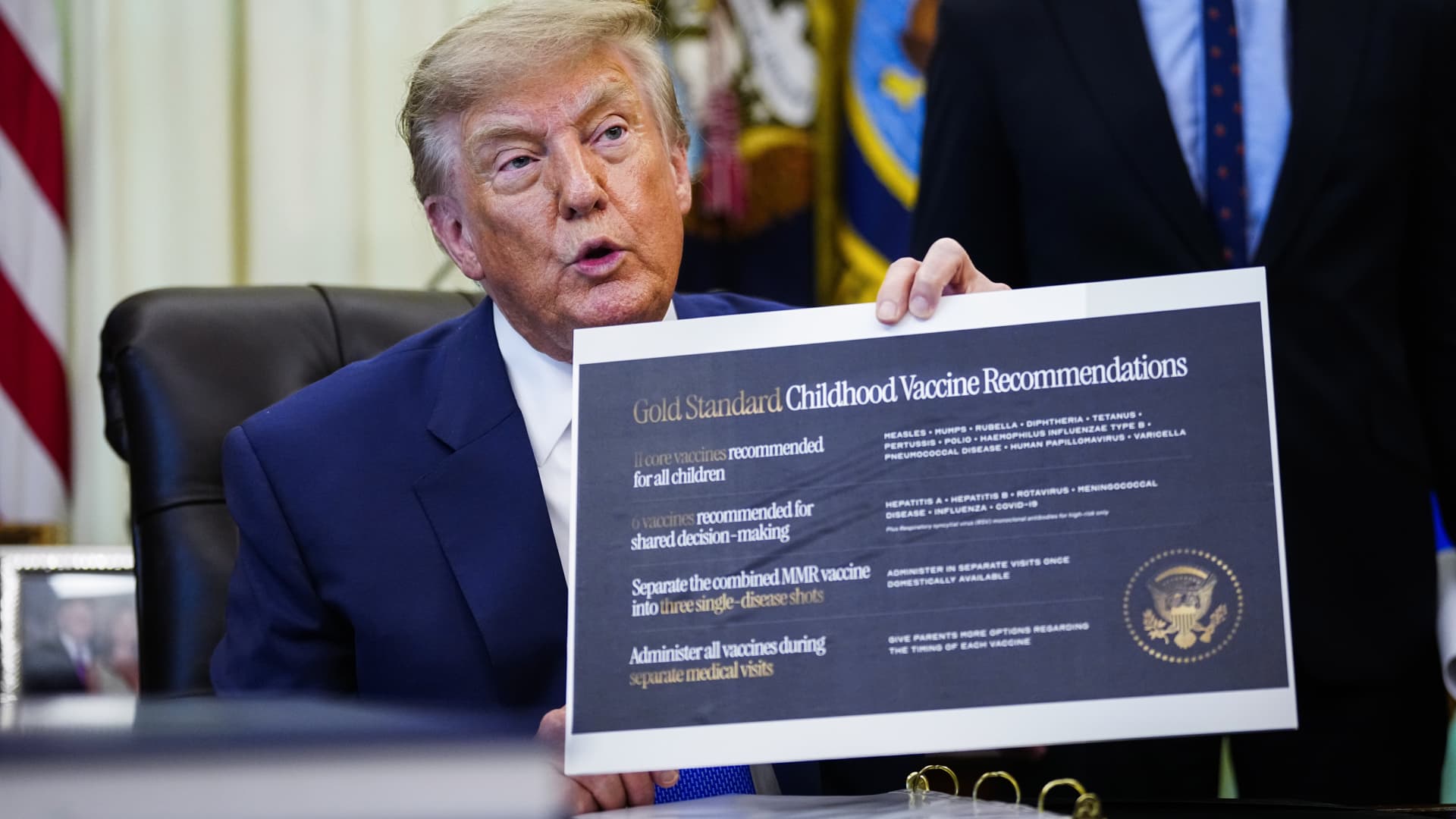
President Donald Trump’s split MMR vaccine proposal is a recommendation, not an immediate change at a pediatrician’s office. The executive order calls for the combined measles, mumps and rubella vaccine to be given as separate shots and urges childhood vaccinations to be administered at separate visits, but experts say no such standalone products are currently licensed in the United States.
That distinction matters for parents: a presidential order does not create new vaccines or alter state school-entry requirements. The BBC reported that school vaccine rules are set by states, so the order serves as federal guidance rather than a mandate.
The current schedule uses two doses of the combined MMR shot: one at 12 to 15 months and another at ages 4 to 6, according to CNBC and the BBC. Splitting each dose into measles, mumps and rubella components could mean six injections across a child’s early years.
Can Trump split the MMR vaccine into separate shots?
Not quickly, based on the practical and regulatory hurdles described by public-health experts. CIDRAP reported that separate measles, mumps and rubella vaccines are not licensed or FDA-approved in the U.S. A manufacturer would need to develop each product, run clinical trials, obtain FDA approval, build production capacity and distribute it.
Merck and GSK make MMR vaccines, CNBC reported. William Moss of Johns Hopkins University told CNBC he did not expect vaccine makers to pursue the extensive approval process for standalone products. Andrew Racine, president of the American Academy of Pediatrics, said development would likely take more than a decade, according to CNBC.
Manufacturers would also need to see sufficient lasting demand for the products. CBS News reported that experts view that as uncertain given the established use of the combined vaccine.
Why do experts oppose separating MMR?
The CDC says there is no published scientific evidence that separating the combination shot provides a benefit, the BBC reported. Multiple studies have found no connection between MMR vaccination and autism, including a 2019 Danish study of 657,461 children cited by the BBC.
Experts’ concerns are largely about access and timing. More appointments can mean more time away from work, higher costs and more chances to miss or postpone a dose, CNBC, CIDRAP and the BBC reported. Families in rural areas or those with limited health-care access could face added friction, Neil Maniar, a Northeastern University public-health professor, told CNBC.
Spacing the vaccines could also leave a child without protection against one of the three diseases until a later visit. The stakes vary by illness: measles is highly contagious; rubella during pregnancy can cause congenital rubella syndrome; and mumps can cause serious complications, including infertility in adolescent males, CBS News reported.
The order may still shape public discussion and state policy, but experts cited by CNBC said they did not expect an immediate effect on the ongoing measles outbreak. For now, the combined two-dose MMR regimen remains the vaccine approach described by the CDC and the American Academy of Pediatrics in the reporting.
This story draws on original reporting from CNBC.


