World Cup drew voters across party lines, CNBC survey finds
CNBC’s poll found nearly half of registered voters watched the World Cup, with income and education creating wider gaps than party affiliation.
By Dev Ramirez · Crypto Correspondent
· 4 min read
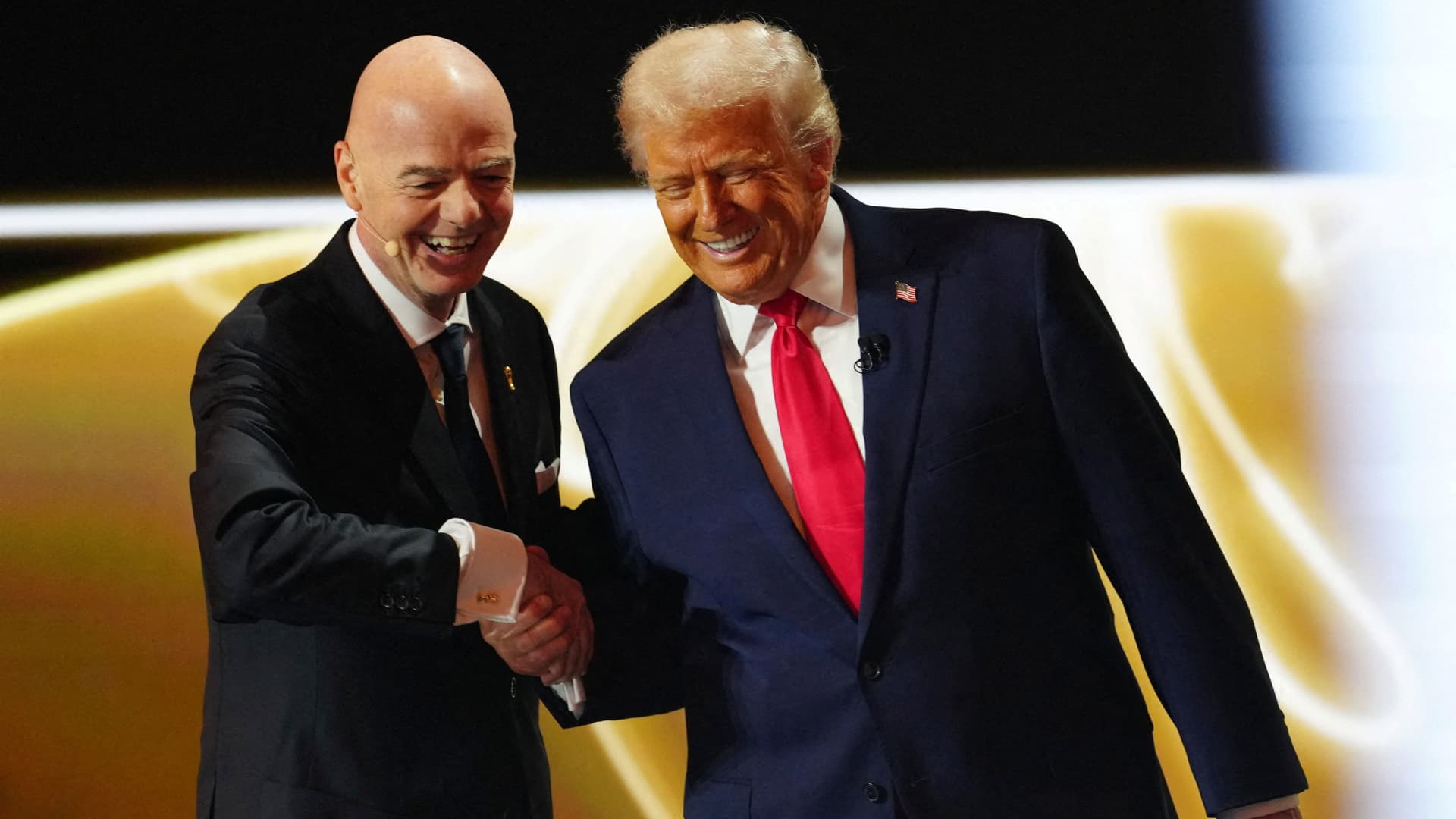
The 2026 World Cup pulled in a politically mixed U.S. audience even as President Donald Trump kept a high profile around the tournament, according to CNBC’s All-America Economic Survey. For investors following sports media and live-event rights, the takeaway is straightforward: the audience was broad, and party affiliation did not appear to be the main dividing line.
CNBC said 49% of registered voters watched at least some of the tournament. The split by party was narrow: 51% of Democrats, 47% of Republicans and 47% of independents said they tuned in.
The survey also found a similar pattern by 2024 vote choice. Among voters who backed Kamala Harris, 51% watched at least some World Cup coverage, compared with 47% of Trump voters. CNBC said voters who approved of Trump and those who disapproved of him also watched at close rates, 47% and 50%, respectively.
Jay Campbell, a partner at Democratic polling firm Hart Research, which conducted the survey with Republican firm Public Opinion Strategies, told CNBC the World Cup was one of the few areas that appeared to cut across partisan lines. Micah Roberts, a partner at Public Opinion Strategies, described the tournament to CNBC as an area where Democrats and Republicans agreed.
Sports preferences were more partisan than World Cup viewing
The World Cup’s four-point gap between Democrats and Republicans was smaller than the divide CNBC found when voters were asked to name their favorite sport.
Republicans were 13 percentage points more likely than Democrats to choose football as their favorite sport. Democrats had seven-point advantages over Republicans in choosing soccer generally and basketball, according to CNBC.
Soccer still ranked as a favorite sport for a relatively small share of voters. CNBC said 8% named soccer as their favorite sport, while 17% said they watched “a lot” of the World Cup and another 32% said they watched “some.”
The tournament also reached viewers beyond U.S. matches. CNBC reported that 88% of World Cup viewers watched games that did not involve the U.S. team. That included 82% of all Republicans and 86% of MAGA Republicans.
Trump’s role did not create a large viewing split
Trump’s involvement with the tournament was extensive, according to CNBC. Since returning to office, he has chaired the White House task force overseeing the World Cup. FIFA President Gianni Infantino appeared with him repeatedly, and FIFA opened offices in Trump Tower.
Trump attended the World Cup draw at the John F. Kennedy Center for the Performing Arts in Washington. CNBC reported that Trump’s name, which he had added to the center, was later required to be removed after a court ruling.
Trump’s annual financial disclosure showed Infantino gave him 10 tickets worth $15,000 to last year’s Club World Cup final, CNBC reported. Trump helped present that trophy and was expected to help present the World Cup trophy at the final at MetLife Stadium in New Jersey.
FIFA later gave Trump its first Peace Prize, according to CNBC, drawing criticism from European lawmakers and an ethics complaint alleging Infantino violated FIFA’s political neutrality rules.
Trump also intervened after U.S. striker Folarin Balogun received a red card, which normally brings an automatic one-match suspension. CNBC reported that Trump called Infantino and asked him to review the decision. FIFA put the suspension on probation, allowing Balogun to play against Belgium. The U.S. lost 4-1 and was eliminated. UEFA called FIFA’s reversal “unprecedented, incomprehensible and unjustifiable,” while FIFA said its disciplinary committee acted under its rules.
Income and education showed wider gaps
CNBC found sharper differences by income and education than by politics. Among voters earning at least $100,000, 59% watched at least some of the World Cup. Among voters earning less than $30,000, 31% watched.
Education showed another large divide. Viewership reached 65% among voters with postgraduate degrees, compared with 40% among voters with a high school education or less. CNBC said those gaps may reflect access to paid television, where millions watched World Cup games.
The CNBC All-America Economic Survey was conducted July 8 through July 12 by Hart Research Associates and Public Opinion Strategies. The poll surveyed 1,000 registered voters nationwide and had a margin of error of plus or minus 3.1 percentage points.
This story draws on original reporting from CNBC.


