Bundesliga study links dirtier air to more fouls
Michael Hirsch and Christian Grund found that higher PM2.5 levels were associated with more fouls in German Bundesliga matches from 2009 to 2024.
By Sofia Marchetti · Columnist
· 3 min read
A study by Michael Hirsch and Christian Grund suggests air quality can change how football is played, not just how it feels to watch. Their analysis of German Bundesliga matches found that players tended to commit more fouls when fine-particle pollution was higher.
For fans, that adds a new layer to match conditions. Weather, home advantage and squad quality already shape a game. Hirsch and Grund’s research points to another variable: the air inside and around the stadium.
The researchers examined air pollution for every Bundesliga match between 2009 and 2024, according to the study. They focused on PM2.5, a measure of tiny airborne particles with a diameter of 2.5 micrometers or less. Because those particles are small enough to be inhaled deeply, PM2.5 is commonly used as a gauge of harmful air pollution.
Hirsch and Grund compared match behavior with pollution levels and reported that fouls rose when PM2.5 was 10 micrograms per cubic meter above average. The increase was not evenly distributed across all players. According to their results, players on weaker teams showed a larger rise in fouls, especially when facing stronger opponents.
Why fouls are the key measure
Football gives researchers a rare setting where pressure, competition and behavior are recorded in detail. Fouls are counted match by match, which makes them easier to study than less visible signs of frustration or poor concentration.
The study’s logic is straightforward: if higher pollution makes emotional control harder, a football match is a place where that effect may show up quickly. A player under stress may mistime a challenge, react more aggressively or lose focus. The box score does not reveal intent, but it does record the foul.
That distinction matters. Hirsch and Grund’s work does not say pollution is the only reason players foul, or that every foul reflects emotion. Matchups, tactics and referee decisions can all affect foul counts. The study reports an association between higher PM2.5 and more fouls across a large set of Bundesliga games.
The team-quality finding is also notable. Players facing stronger opponents may already be under more pressure, and the study found that higher pollution coincided with a bigger increase in fouls for those players. In plain terms, bad air appeared to be linked with more physical play where the competitive gap was wider.
Stadium smoke adds another wrinkle
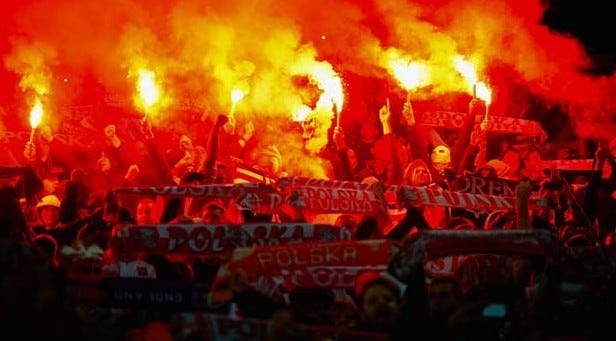
The discussion also points to a practical stadium issue: pyrotechnics. Burning flares and similar devices can sharply increase particulate matter in a stadium, raising the same type of pollution measured by PM2.5.
That does not mean pyrotechnics were the core subject of the Bundesliga analysis. The main finding from Hirsch and Grund is broader: across 15 years of Bundesliga matches, dirtier air was tied to more fouls per player.
For clubs, leagues and fans, the takeaway is less about blaming one tackle on one bad-air day and more about recognizing that environmental conditions may influence behavior on the pitch. In a sport where small edges and small mistakes can decide results, air quality may be more than background noise.
This story draws on original reporting from Klement on Investing.