Climate news exposure tied to lower first-birth odds in UK study
Weychert et al. found age and partnership status mattered most, while climate concern mattered only when paired with heavy climate-news exposure.
By Priya Nair · Economy Reporter
· 3 min read
A 2026 working paper by Weychert et al. adds a narrower point to the debate over falling birth rates: climate anxiety alone was not linked to lower odds of having a first child among British respondents, but climate concern combined with heavy climate-news exposure was.
The finding matters because it separates two ideas that are often blended together. Researchers looking at British people found that being worried about the environment did not, by itself, make someone less likely to become a parent for the first time. Getting a lot of climate-related news also did not, by itself, show that effect.
The paper, published through the University of Warsaw’s Faculty of Economic Sciences working paper series, examined determinants of first births in Britain. According to Weychert et al., the strongest factors were the familiar ones: age and marital or partnership status.
Respondents were more likely to have a first child as they got older, up to a point, the researchers found. People who were married or living with a partner were also much more likely to have a first child than those who were not.
Other characteristics tested in the paper did not show the same influence. Educational attainment and political orientation were not found to affect the decision to have children, according to the researchers.
Where climate concern showed up
The climate-related result was more specific. Weychert et al. found a small effect only among people who were both highly concerned about climate change and heavily exposed to climate-change news.
That group was about 62% less likely to have a first child than people who were concerned about the environment but did not receive a high volume of climate news, according to the paper. In plain terms, the study does not say environmental concern broadly reduces family formation. It says the combination of high concern and high exposure to climate coverage was associated with lower first-birth probability.
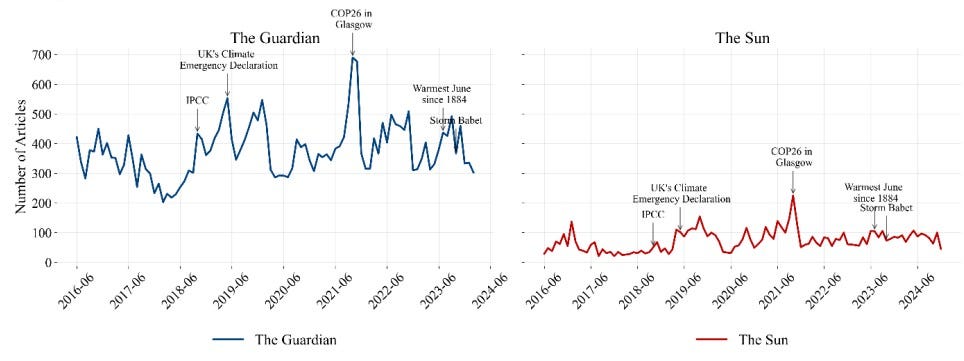
The paper also compared climate-change coverage in two UK newspapers: The Guardian and The Sun. The Guardian is described by YouGov as left-leaning, while The Sun is described as right-leaning. A chart cited to Weychert et al. showed the number of climate-change articles in each publication.
The broader backdrop is a well-known demographic shift: younger people are marrying later, having children later and having fewer children. The discussion around that shift often includes financial insecurity, longer periods living at home and the rising cost of child care, particularly in countries where child care has become more expensive.
Weychert et al.’s result does not establish climate news as the main driver of lower birth rates. It points to a narrower association in the data: among British respondents, age and partnership status did most of the work, while climate concern mattered only when paired with heavy exposure to climate-change news.
This story draws on original reporting from Klement on Investing.