Government debt can weaken monetary policy, study finds
A 2026 study finds higher U.S. public debt was associated with smaller output and unemployment responses to monetary shocks.
By Sofia Marchetti · Columnist
· 3 min read
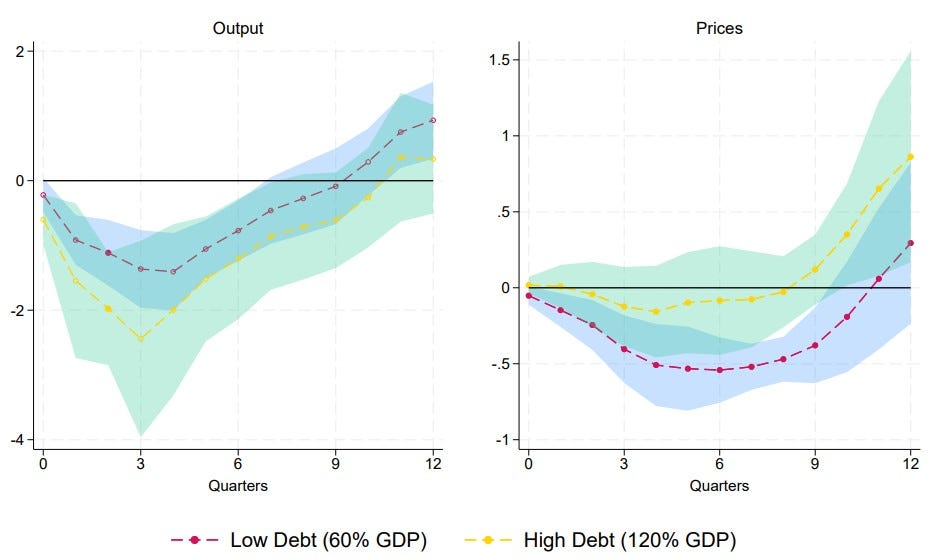
Government debt monetary policy links may be more important to investors than the usual rate-decision headline suggests. A 2026 study of U.S. data finds that when debt is relatively high, output and unemployment responded less strongly to the same monetary-policy shock, though the result is specific to its model and data.
Central banks generally use a short-term policy rate to influence borrowing costs across the economy. The International Monetary Fund says higher rates can curb financed consumer purchases and business activity, while lower rates are intended to support demand. Because prices and wages can adjust slowly, those policy changes can affect production in the short run.
How does government debt change monetary policy?
In “Monetary Policy and Government Debt”, Nicolas Caramp and Ethan Feilich examine whether the level of public debt changes how sensitive economic activity is to interest-rate moves. Their New Keynesian model assumes non-Ricardian fiscal policy and risk-free government debt.
The authors’ proposed mechanism is a wealth effect from government bonds. In their model, those wealth effects weaken the path from an interest-rate change to output. That is a modeled explanation in the paper, rather than proof that it is the only channel at work in every economy.
Using data on private ownership of U.S. public debt, the researchers found smaller responses to a monetary shock when the debt-to-GDP ratio was one standard deviation above its average. Industrial production’s response was 0.75 percentage point smaller and unemployment’s response was 0.1 percentage point smaller, at horizons of up to three years, according to the article’s abstract.
Those figures describe differences in how the two measures reacted to the same type of shock. They do not say that industrial production or unemployment themselves changed by those amounts, and they should not be read as an estimate for any particular Federal Reserve rate decision.
What the research does and does not show
The study addresses the potency of rate moves, not whether a given debt level is sustainable or what the Fed should do next. Its evidence is based on U.S. public debt held privately and on a particular model, so the estimates cannot automatically be applied to other countries, other fiscal systems or debt structures with different maturities and holders.
There is a separate budget consideration. The Government Accountability Office says that as federal debt and interest rates increase, the government’s borrowing costs and interest spending rise. That observation does not establish the paper’s monetary-transmission mechanism, but it shows why the government’s balance sheet can become more relevant when rates move.
For readers following central banks, the takeaway is narrow: policy rates still work through borrowing costs and demand, according to the IMF, but the size of that effect may depend in part on the government debt setting. Caramp and Feilich’s findings add U.S.-specific evidence to that question, rather than a universal rule for rate policy.
This story draws on original reporting from Klement on Investing.