Older homeowners are reshaping the housing math for younger buyers
Boomers’ wealth and reluctance to downsize are keeping more large homes out of younger families’ reach, according to reports from WSJ, NYT and Pew.
By Priya Nair · Economy Reporter
· 3 min read
Older Americans are changing the housing market by staying in large homes, and in some cases buying larger ones after retirement. For younger investors and would-be buyers, that affects both the homeownership path and the way wealth may get built outside real estate.
The Wall Street Journal reported that upsizing in retirement has become more common among affluent older households. The Journal said baby boomers and older Americans hold about $110 trillion in total wealth, helped by decades of gains in home values and stocks.
That wealth gives many retirees choices younger buyers do not have. A Wealth of Common Sense noted that many boomers have paid off their homes and can buy properties with cash, adding that boomers account for 42% of current homebuyers.
The pattern cuts against a familiar retirement script: sell the family home, buy something smaller, and free up cash. The Journal quoted Merrill Lynch financial adviser April Tardiff as saying eight of her clients retired this year and all eight bought larger homes. She said only one client had downsized in the past five years.
For younger households, the supply issue is straightforward. If older owners keep family-size houses longer, fewer of those homes are available for buyers with children. If wealthier retirees also compete for homes, they can add pressure in markets where supply is already tight.
Kyla Scanlon, writing in The New York Times, pointed to a wide generational split in housing wealth. Since 2010, Americans age 55 and older have added about $20 trillion in real estate wealth, while Americans under 40 have added $3.5 trillion, she wrote. Scanlon also wrote that two-thirds of the housing wealth added since then is now held by Americans 55 and older.
The ownership gap is visible in larger homes. Scanlon wrote that empty nesters own about 28% of large homes in the U.S., while millennials with children own about 16%.
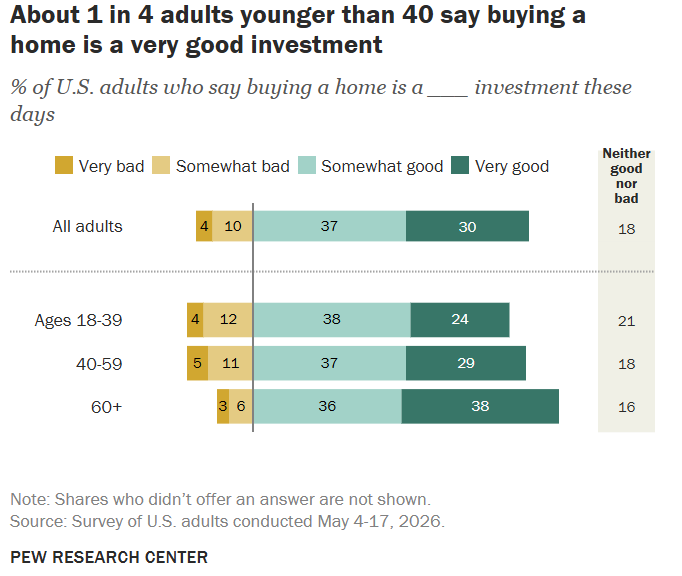
That helps explain why younger adults may view housing differently than older generations. Pew Research found that only about one-quarter of adults ages 18 to 39 consider housing a very good investment, a much lower share than among people 60 and older.
A Wealth of Common Sense connected that shift to the stock market, saying equity holdings among people under 40 have risen in the 2020s as housing has become unreachable for many households. Equity holdings means ownership of stocks or stock funds, such as broad index funds held in brokerage or retirement accounts.
Housing can still create wealth, but the comparison with stocks is less automatic than many buyers assume. Alison Schrager wrote for Bloomberg that Nantucket’s median home price is nearly $4 million, up from $500,000 in 1995. She added that $500,000 invested in the S&P 500 Index in 1995 would be worth more than $8.2 million today, with even more if dividends were reinvested.
Homes also carry costs that stock index returns do not: repairs, maintenance, taxes, insurance and transaction fees. A Wealth of Common Sense argued that those expenses can make housing returns lower than headline price gains suggest, while also acknowledging that owning a home can provide an emotional benefit a portfolio cannot.
The broader pressure point is supply. A Wealth of Common Sense argued that building more homes would address many affordability problems, especially for younger buyers, while saying policymakers have not made that a priority. Until supply catches up, younger households may keep facing a harder choice between stretching for a home and building wealth through other assets.
This story draws on original reporting from A Wealth of Common Sense.