Political investing hedge funds lagged less aligned peers, study finds
A Singapore Management University study found hedge funds aligned with a president’s policies trailed less aligned portfolios by about 4.4% a year.
By Sofia Marchetti · Columnist
· 3 min read
Political investing hedge funds performed worse when their portfolios lined up closely with the economic agenda of the sitting U.S. president, according to a Singapore Management University study posted to SSRN. For individual investors, the finding is a clean warning: political conviction and market edge are not the same thing.
The study examined the holdings of U.S. hedge funds and compared those portfolios with the economic policies of the incumbent president. The researchers measured how individual U.S. stocks reacted to presidential economic policy announcements, then used those reactions to estimate how sensitive each hedge fund portfolio was to the president’s agenda.
The researchers also compared portfolio positioning with the political donations made by hedge fund managers. According to the study, managers whose donations showed political alignment with the president tended to hold portfolios that were also more exposed to the president’s economic policies.
Do political views hurt hedge fund returns?
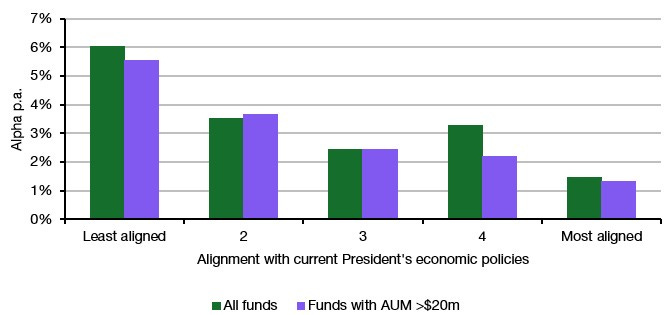
The study found that hedge fund portfolios most aligned with the president’s economic policies underperformed the least aligned portfolios by about 4.4% per year, after adjusting for the Fung and Hsieh hedge fund risk factors. Alpha means the return left over after accounting for common risk exposures, so the result points to weaker performance beyond what those standard hedge fund risk factors would explain.
The proposed explanation is straightforward. A president’s broad economic priorities are public information, so stocks expected to benefit from those policies may already reflect much of that optimism in their prices. Stocks seen as less favored by the president’s policies may be avoided by investors making the same political bet, which can set them up for better future returns, according to the study’s interpretation.
That does not mean the study proves politics caused the underperformance. The analysis can show a relationship between political alignment, portfolio choices and later returns, but the exact cause is harder to pin down.
The researchers tested the pattern further by looking at unexpected events that increased political polarization, including mass shootings and political protests in cities where the hedge funds were based. After those events, hedge funds that were already aligned with the president’s policies became even more aligned, and then underperformed by more, according to the study.
The finding cuts across a familiar retail-investing argument. Some investors exclude industries for environmental, social and governance reasons, while others reject areas such as wind and solar energy because they disagree with climate policy. The study’s hedge fund evidence suggests that even professional investors can let political identity influence portfolio construction in ways that may hurt returns.
For investors managing their own accounts, the takeaway is practical rather than partisan. A stock’s return depends on price, expectations and future cash flows, not whether the company fits a voter’s preferred policy story. The Singapore Management University study adds evidence that when politics becomes an investing screen, the market may already have priced in the obvious part.
This story draws on original reporting from Klement on Investing.