Study finds some stock news can take months to show up in prices
An NBER working paper says news that clashes with the market’s dominant story is often priced in slowly, especially at smaller companies.
By Sofia Marchetti · Columnist
· 3 min read
A new NBER working paper suggests investors may miss some market-moving company news when it does not fit the story already driving a stock. For everyday investors, the takeaway is practical: prices may react fast to headline themes, while less obvious news can take much longer to show up.
The paper, cited as Didisheim et al. (2026), studied U.S. stocks from 1996 through 2022 and used large language models, or LLMs, to sort company news across several dimensions. LLMs are artificial-intelligence systems that can process and classify large amounts of text, which let the researchers scan news at a scale most individual investors cannot match.
The researchers found that a company’s news flow can be predicted from its earlier news flow. They then treated the gap between expected news and actual news as a “news surprise.” In plain English, that means the study looked for items that did not match the kind of coverage a company had recently been getting.
According to Didisheim et al., those surprises were often reflected in share prices slowly. The study says that process can take as long as 18 months when the new information challenges the market’s existing narrative about a company.
Why narratives can slow price reactions
The study’s core idea is that investors do not process every piece of information equally. When one narrative dominates coverage, investors tend to focus on news that reinforces it. News that cuts against that story, or sits outside it, can receive less attention even when it is relevant to a company’s value.
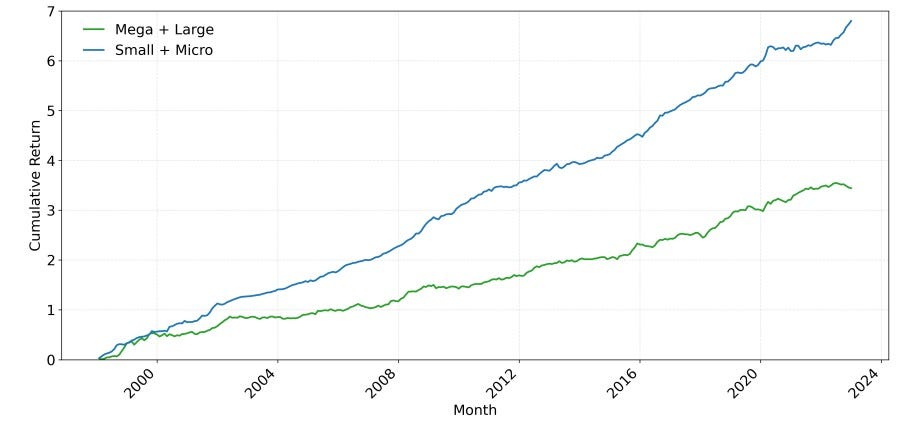
That effect was strongest in smaller, less liquid stocks, according to the analysis. Liquidity means how easily shares can be bought or sold without moving the price much. Smaller stocks often trade less heavily, so information can spread through the investor base more slowly.
Didisheim et al. also found that paying attention to news surprises that contradict the dominant story added the most value in smaller companies. The study said the effect remained meaningful for large-cap stocks as well, though it was less pronounced.
Which kinds of news were most often missed
The paper’s analysis points to three categories that accounted for about 70% of the under-the-radar news surprises:
- Corporate actions, including deals, financings and restructurings.
- Signals of distress or possible delisting, where credit analysis may help identify financial stress earlier.
- Changes in company guidance or outlook, meaning management’s updates on expected business performance.
Those categories matter because they can change the economics of a business even when they do not fit the headline theme investors are already tracking. A restructuring, for example, can alter a company’s balance sheet or cost base. A guidance change can reset expectations for revenue, profit or cash flow.
The broader point from the study is not that investors can easily copy the researchers’ process. Running LLMs across a large universe of stocks is beyond the normal toolkit for most people managing a portfolio on their own.
But the research does offer a useful way to read market news. Investors can first identify the dominant story surrounding a stock or the broader market, then watch for credible company updates that either conflict with that story or fall outside it. Didisheim et al. suggest those are the kinds of surprises that may take longer to be absorbed into prices.
The study does not say every overlooked news item will move a stock, and it does not offer a trading rule that removes risk. It does show that attention itself can be uneven, and in markets, what investors fail to notice quickly can be as relevant as what makes the front page.
This story draws on original reporting from Klement on Investing.