U.S. economy tests old recession signals as growth holds up
A Wealth of Common Sense points to fewer recessions, frozen housing, steady yields and normal-looking growth as key investor questions.
By Sofia Marchetti · Columnist
· 3 min read
The U.S. economy keeps resisting several signals that used to make investors nervous: weak housing activity, high federal debt and inflation above the last decade’s norm. A Wealth of Common Sense argues that the current setup leaves retail investors with four big questions about how to read the cycle.
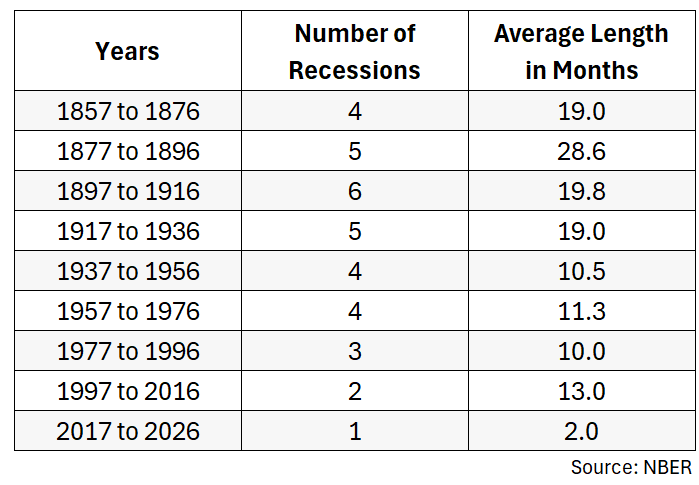
The first is why recessions have become less frequent. A recession is a broad decline in economic activity, and the National Bureau of Economic Research, the group that dates U.S. business cycles, has expansion and contraction data going back to the 1850s. A Wealth of Common Sense notes that 19th-century data may be less reliable than modern data, but says the long-term pattern still shows downturns have become rarer.
According to the blog, the U.S. has had only one recession in the past 17 years. That downturn lasted two months and did not include a credit cycle, meaning it was not driven by a boom-and-bust in borrowing and lending. The blog points to a larger, more diversified economy, a bigger services sector, more technology, more efficient companies and faster policy responses as possible reasons.
That has not removed risk from markets. A Wealth of Common Sense says bear markets, commonly defined as stock declines of 20% or more, have still happened, though recent ones have been relatively short. The blog raises the possibility that investors could react more sharply when the next contraction arrives because long recessions have become less familiar.
Housing is weak, but the economy has held
The second question centers on housing. A National Bureau of Economic Research paper cited by A Wealth of Common Sense says housing activity, which accounts for nearly 20% of gross domestic product, has been the main driver of U.S. economic cycles since World War II. Gross domestic product, or GDP, is the broadest measure of output in the economy.
Existing home sales have fallen sharply, according to the blog, as mortgage rates have stayed above 6% for more than three years and affordability has been strained. A Wealth of Common Sense says the damage has been limited so far because home prices did not crash, many homeowners locked in mortgage rates near 3%, and unemployment has stayed below 5% for almost five years.
Bond yields do not show a debt panic
The third question is why interest rates are not higher. A Wealth of Common Sense says inflation remains above last decade’s levels, federal debt is extremely high, deficits appear persistent, and debt as a share of GDP is near its highest level outside World War II.
Even so, the blog says the 10-year Treasury yield remains below its average over roughly the past 65 years. The 10-year yield matters because it helps set borrowing costs across mortgages, corporate debt and other loans. A Wealth of Common Sense argues that current bond yields look more normal than crisis-like, especially compared with the near-zero-rate period after the global financial crisis.
A more normal economy, for now
The final question is whether the economy has settled into something closer to normal. A Wealth of Common Sense lists current U.S. growth in the 2% to 3% range, inflation at 3.5%, the 10-year Treasury yield just below 5%, and the U.S. stock market up 10% in the first half of the year.
The blog says those figures come after a stretch that included the pandemic, supply-chain shocks, a hot labor market, 9% inflation, Federal Reserve rate increases, tariffs, energy shocks and multiple wars. Its conclusion is cautious: the current data may look more normal, but the blog does not assume that calm will last.
This story draws on original reporting from A Wealth of Common Sense.