AI wealth distribution debate expands from public stakes to shorter workweeks
Economists and tech researchers are floating ways to share AI gains, from data payments and public funds to corporate taxes and shorter hours.
By Maya Okafor · Markets Writer
· 4 min read
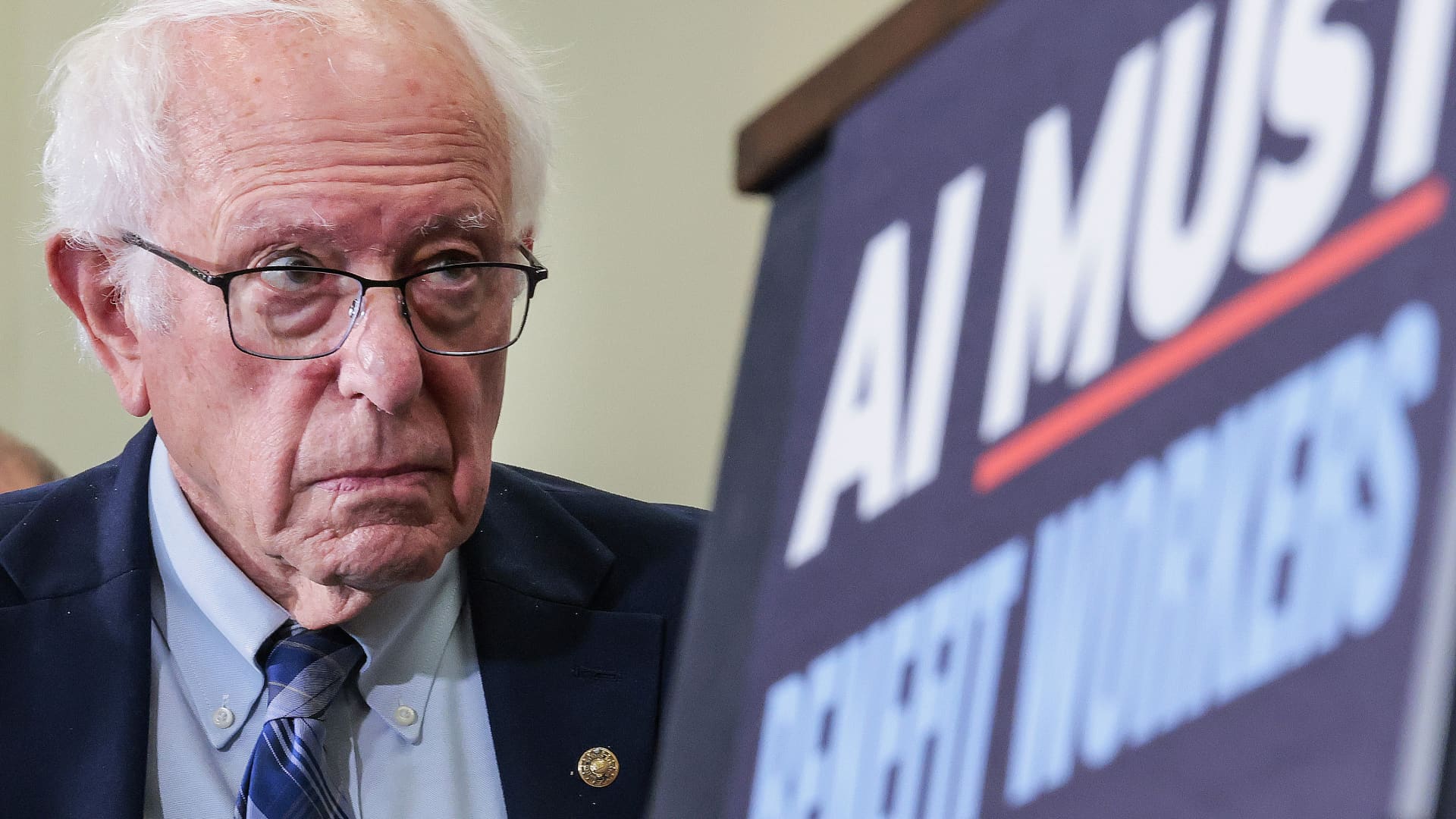
The fight over AI wealth distribution is moving into policy circles as artificial intelligence creates stock-market gains while many workers see more risk than reward. For everyday investors, the debate matters because it could shape how future AI profits are taxed, owned or shared across the economy.
Sen. Bernie Sanders’ proposal for the public to own half of artificial intelligence is not expected to become law soon, CNBC reported. Still, economists, technology researchers and policymakers are discussing a range of mechanisms for sharing the trillions of dollars in economic value that AI supporters expect the technology to produce.
Public skepticism is rising alongside those proposals. An Emerson College poll released this week found that 27% of Americans support data centers being built in or near their communities, while 63% oppose them. A December 2025 poll found 33% support and 42% opposition, showing a sharp shift against local AI infrastructure projects in less than a year.
At an April public comment session over a proposed 257-acre data center campus in Portage County, Ohio, resident Will Hollingsworth said he saw “a gamble” in which large technology companies benefited while the county absorbed the costs. His comments spread widely online and captured a concern running through the broader debate: many communities are being asked to host AI infrastructure without a clear share of the upside.
How would an AI wealth fund work?
An AI sovereign wealth fund would be a government-linked investment vehicle designed to collect value from AI companies and distribute benefits to the public. The idea is similar to state funds that hold assets on behalf of citizens, except the assets would be tied to AI growth through equity stakes, taxes or other payments.
CNBC reported that recent survey work found a majority of U.S. workers support holding corporations accountable through an AI sovereign wealth fund. CNBC also reported unconfirmed discussions in which OpenAI considered offering the U.S. government a 5% equity stake ahead of a potential IPO. Separately, Jeff Bezos told CNBC that eliminating federal income taxes for the bottom half of U.S. earners would be the best policy idea to reduce economic inequality.
Paying people for the data behind AI
One proposal focuses on training data, the information used to teach AI models how to generate answers, images and other outputs. Computer scientist Jaron Lanier of Microsoft Research has argued for “data dignity,” a system in which people are paid for the human contributions that make AI systems useful.
Lanier told CNBC that the design of any public benefit system would depend on the government responsible for distributing the money. He said he prefers a more distributed economic model unless Silicon Valley treats people as useless by hiding their contributions behind anonymized data.
Raul Castro Fernandez, an assistant professor of computer science at the University of Chicago, told CNBC that profit sharing could be built around human contributions rather than a tax. He said AI companies already estimate how much data improves model performance and could pay a share of profits into a pool, with distributions made through audited measures similar in spirit to music royalties.
Other researchers are skeptical. Nicholas Vincent of Simon Fraser University and Brent Hecht of Northwestern University wrote in a 2023 study that small design choices can meaningfully change how data value is assigned. They also argued that if millions or billions of people contribute to a system, each person’s individual payout may be very small.
Other ideas: unions, taxes and fewer hours
Matt Prewitt, president of the RadicalxChange Foundation, has proposed new legal rights that people would exercise collectively through associations rather than signing away individually. He told CNBC those groups could seek compensation, governance rights and other power in dealings with AI companies.
Dean Baker, co-founder of the Center for Economic and Policy Research, told CNBC that existing tools may be enough: stronger corporate taxes, tougher antitrust enforcement and labor protections. He suggested companies could turn over non-voting shares equal to a targeted tax rate, such as 25% of shares for a 25% tax rate.
Baker also pointed to shorter workweeks as a direct way to share productivity gains if AI delivers them. He said the 40-hour week was set 90 years ago and suggested lowering the threshold to 32 hours, while potentially raising the overtime premium to 100% from 50%.
This story draws on original reporting from CNBC.