Microsoft signs on for AMD’s Helios AI racks in Azure
AMD’s first full AI rack system will ship later this year, with Microsoft joining Meta, OpenAI and Oracle as early customers.
By Jordan Bell · Startups & Deals Reporter
· 4 min read
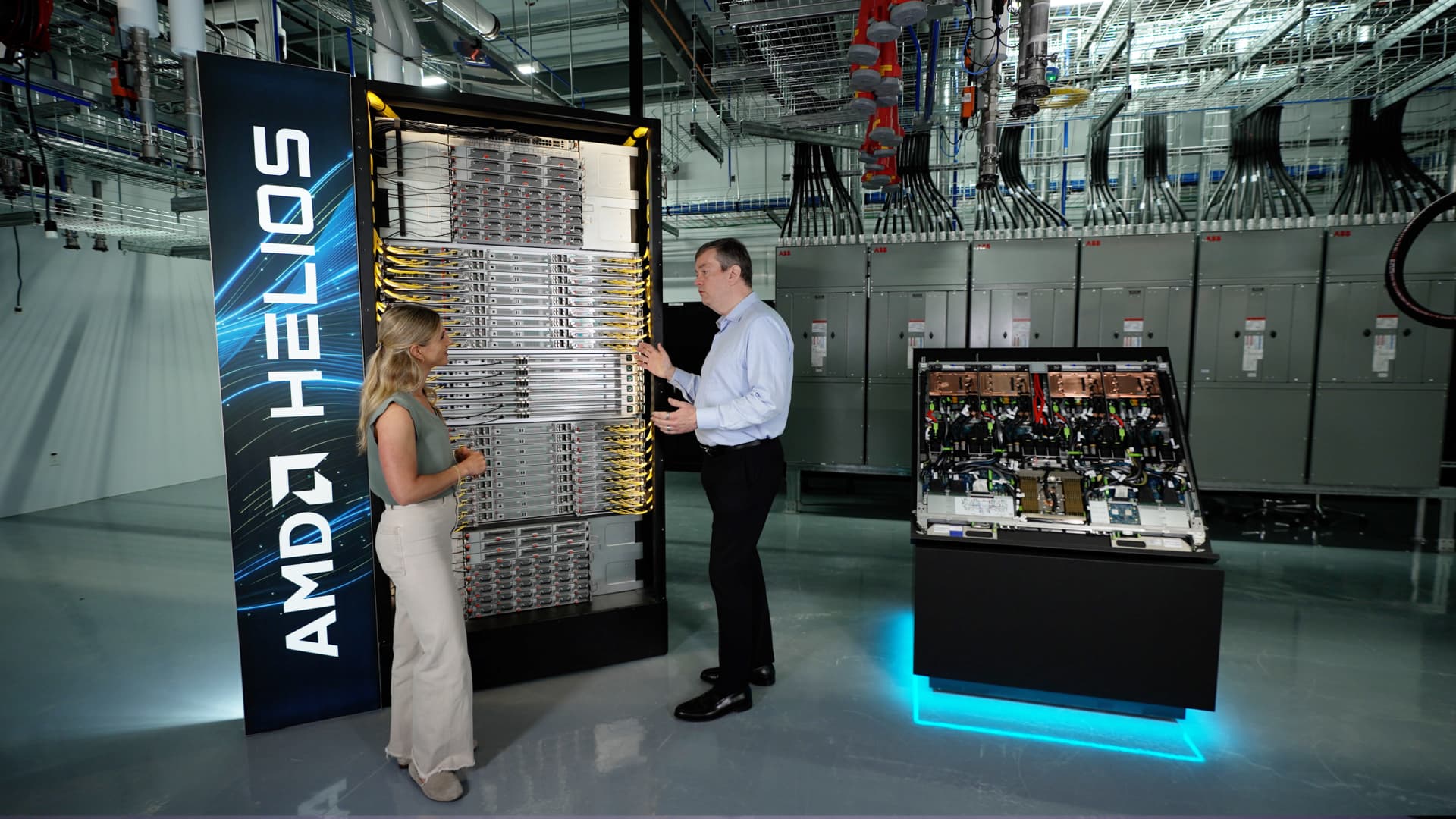
Microsoft will put AMD’s new Helios AI racks into Azure data centers, giving AMD a marquee cloud customer for its first full-system challenge to Nvidia’s AI hardware stack. For investors, the deal broadens AMD’s AI pitch from selling individual chips to selling an integrated data-center system, though Microsoft and AMD did not disclose pricing or capacity.
Microsoft said Monday it will deploy Helios for Azure, joining earlier customers including Meta, OpenAI and Oracle. AMD plans to start shipping the system later this year, CNBC reported.
A rack-scale system is a full cabinet of computing gear designed to work as one unit. In AI data centers, that means graphics processing units, or GPUs, do the heavy math for training and running models; central processing units, or CPUs, coordinate workloads; networking chips move data between machines; and software helps developers use the hardware efficiently.
Microsoft CEO Satya Nadella said in a press release that Azure is adding AMD Helios to give customers “performance, scale and choice” for new AI applications. Microsoft said Helios will support frontier model inference, Azure AI services and Microsoft’s AI customers. Inference is the stage when an already-trained AI model generates an answer, image, code or other output for a user.
Microsoft also said it will add two Azure computing instances based on AMD’s latest “Venice” CPUs. One is aimed at agentic AI and data pipelines, and the other at semiconductor design.
AMD is chasing Nvidia at the system level
Helios is AMD’s first AI system built at rack scale. CNBC described it as AMD’s most direct answer yet to Nvidia’s Grace Blackwell and Vera Rubin systems, which combine chips, networking and software for large AI workloads.
The competitive gap remains large. Nvidia has more than 95% of the data-center GPU market, according to Futurum Group, while AMD has about 4.5%. Futurum CEO and analyst Daniel Newman told CNBC that AMD could make a meaningful move if it reaches 20% to 25% share, adding that the opportunity represents hundreds of billions of dollars in revenue.
AMD told CNBC that eight of the top 10 AI companies run workloads on its Instinct GPUs, including OpenAI, Cohere and Elon Musk’s SpaceXAI, which is part of SpaceX. Meta said in February that it would use up to 6 gigawatts of AMD GPUs over time, beginning with 1 gigawatt on Helios racks later this year, according to CNBC. Tata Consultancy Services has also committed to use Helios.
AMD data-center chief Forrest Norrod told CNBC the company is focused on total cost of ownership and “the lowest cost per token.” A token is a small unit of text or data that an AI model processes, so cost per token is one way cloud companies measure how expensive it is to run AI services at scale.
AMD has not disclosed Helios pricing. Futurum estimates the system will cost $5 million to $5.5 million, compared with $3.5 million to $4 million for Nvidia’s Vera Rubin system. CNBC reported that Helios can weigh as much as 7,000 pounds and is wider and heavier than Vera Rubin.
Software remains a key test
Each Helios system uses four pieces AMD makes or controls: GPUs, CPUs, networking and software. CNBC reported that each of the system’s 18 compute trays includes four Instinct GPUs powered by one EPYC CPU, plus as many as 12 networking chips using technology from AMD’s 2022 Pensando acquisition.
AMD’s recent acquisitions have helped build that full-system approach. The company bought Xilinx for nearly $50 billion in 2022, ZT Systems for nearly $5 billion in 2025, and several software companies tied to ROCm, AMD’s open-source alternative to Nvidia’s CUDA software platform.
Counterpoint Research analyst Neil Shah told CNBC that AMD’s chips are “on par” with Nvidia’s GPUs and CPUs, but said Nvidia remains ahead in software because CUDA has a larger ecosystem.
For AMD, Helios arrives as data centers have become its core growth engine. In the first quarter of 2026, data centers accounted for the majority of AMD’s revenue, up 57% from a year earlier. AMD told CNBC it expects tens of billions of dollars in data-center AI revenue starting in 2027, with most of that coming from Helios.
This story draws on original reporting from CNBC.