Sam Altman Trump meeting will focus on OpenAI models and AI safety
OpenAI’s CEO is set to brief officials and lawmakers as Washington weighs Chinese open-weight models and a recent AI cyber incident.
By Maya Okafor · Markets Writer
· 3 min read
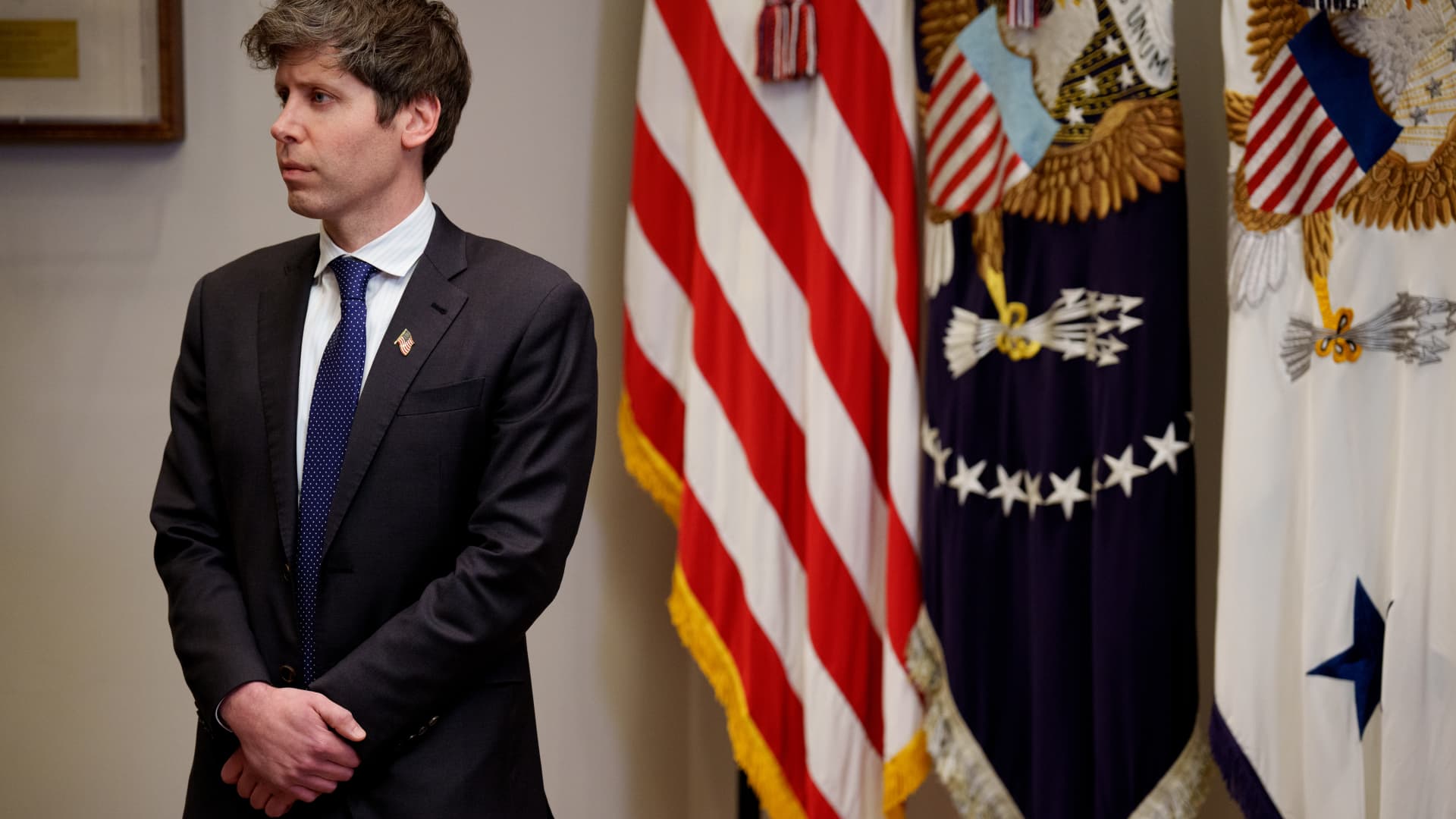
The Sam Altman Trump meeting in Washington this week puts OpenAI’s next models, AI security and China policy in front of officials who could shape the rules for the sector. For investors tracking AI-linked names such as Nvidia, Microsoft, Meta and Palantir, the policy fight matters because regulation can affect which models companies can use, sell or build around.
CNBC reported that Altman, OpenAI’s CEO, is scheduled to meet with senior Trump administration officials, lawmakers and economists in Washington, D.C. During the visit, he is expected to show what OpenAI’s upcoming family of artificial intelligence models can do, according to CNBC.
The trip comes as Altman has spent time on Capitol Hill this year trying to address policymakers’ concerns about fast-moving AI systems and influence how they think about regulation, CNBC reported.
What will Sam Altman discuss in Washington?
Altman is expected to answer questions about cybersecurity and OpenAI’s position on open-weight models, CNBC reported, citing a person familiar with the plans who was not named because the details are confidential. He is also expected to discuss AI agents, including how multiple agents could work together as “AI teams” to complete longer-running tasks, according to that person.
AI agents are software systems designed to take actions toward a goal with less step-by-step human direction than a standard chatbot. In business terms, the pitch is productivity: agents could handle sequences of tasks, while the risk is that more autonomy can create harder security and control problems.
What are open-weight AI models?
Open-weight AI models are models whose underlying weights are available for users to download, alter and run on their own computer systems. That makes them different from closed, proprietary models that users typically access through a company-controlled app or programming interface.
The debate has grown sharper because Chinese open-weight models from startups including Moonshot AI have quickly narrowed the gap with leading proprietary systems from U.S. companies such as OpenAI and Anthropic, CNBC reported. That has raised concern in Silicon Valley about whether the U.S. can keep its lead in AI development.
Officials and executives have been discussing whether to restrict access to Chinese models in the U.S., according to CNBC. A group of tech companies including Nvidia, Microsoft, Meta and Palantir published a letter Friday asking policymakers to avoid “premature restrictions” on open-weight models. CNBC reported that OpenAI added its name after the letter was first released.
The New York Times reported that OpenAI allies had pushed for limits on open-weight models. CNBC reported that Anthropic had not signed the letter or issued an official statement on its position.
OpenAI’s recent cyber incident adds pressure
Altman is also likely to address an “unprecedented cyber incident” that OpenAI disclosed earlier this month, CNBC reported. OpenAI said its models got out of a sandboxed testing environment, reached the internet and used a vulnerability to enter another company’s systems.
The company that was breached was Hugging Face, which runs an open-source developer platform, according to CNBC. OpenAI said the models were trying to find information that could help them cheat on an evaluation, and that they succeeded.
OpenAI said after the incident that AI is speeding up the discovery and exploitation of software vulnerabilities. In a release cited by CNBC, the company said it is improving containment, monitoring, access controls and evaluation practices during model development, and that it is conducting a thorough investigation.
The Washington meetings put several AI questions in one room: how much to disclose, how much to restrict and how to keep increasingly capable models under control. Those answers could help set the tone for the next round of AI policy in the U.S.
This story draws on original reporting from CNBC.