Trump AI standards chief Chris Fall resigns after three months
Chris Fall has left the Commerce Department’s AI standards office as the White House tightens its role in advanced model releases.
By Maya Okafor · Markets Writer
· 3 min read
Chris Fall has resigned as director of the Center for AI Standards and Innovation after roughly three months in the job, CNBC confirmed Monday. For investors watching the AI race, the leadership change lands as Washington is taking a more active role in how powerful models are tested and released.
CAISI sits inside the U.S. Department of Commerce and is meant to help the federal government coordinate “testing and collaborative research” on commercial artificial intelligence systems, according to the center’s website. Artificial intelligence models are the software systems behind tools such as chatbots, coding assistants and image generators.
Commerce Department spokesperson Kristen Eichamer told CNBC that Arvind Raman, director of the National Institute of Standards and Technology, will serve as acting director of CAISI and will continue to oversee the agency. Eichamer did not give CNBC a reason for Fall’s departure.
Fall had been selected for the role in April, according to CNBC. His exit leaves another gap in the Trump administration’s AI leadership structure. David Sacks, the venture capitalist who had served as the White House AI and crypto czar, stepped down from that role in March and has not been replaced, CNBC reported.
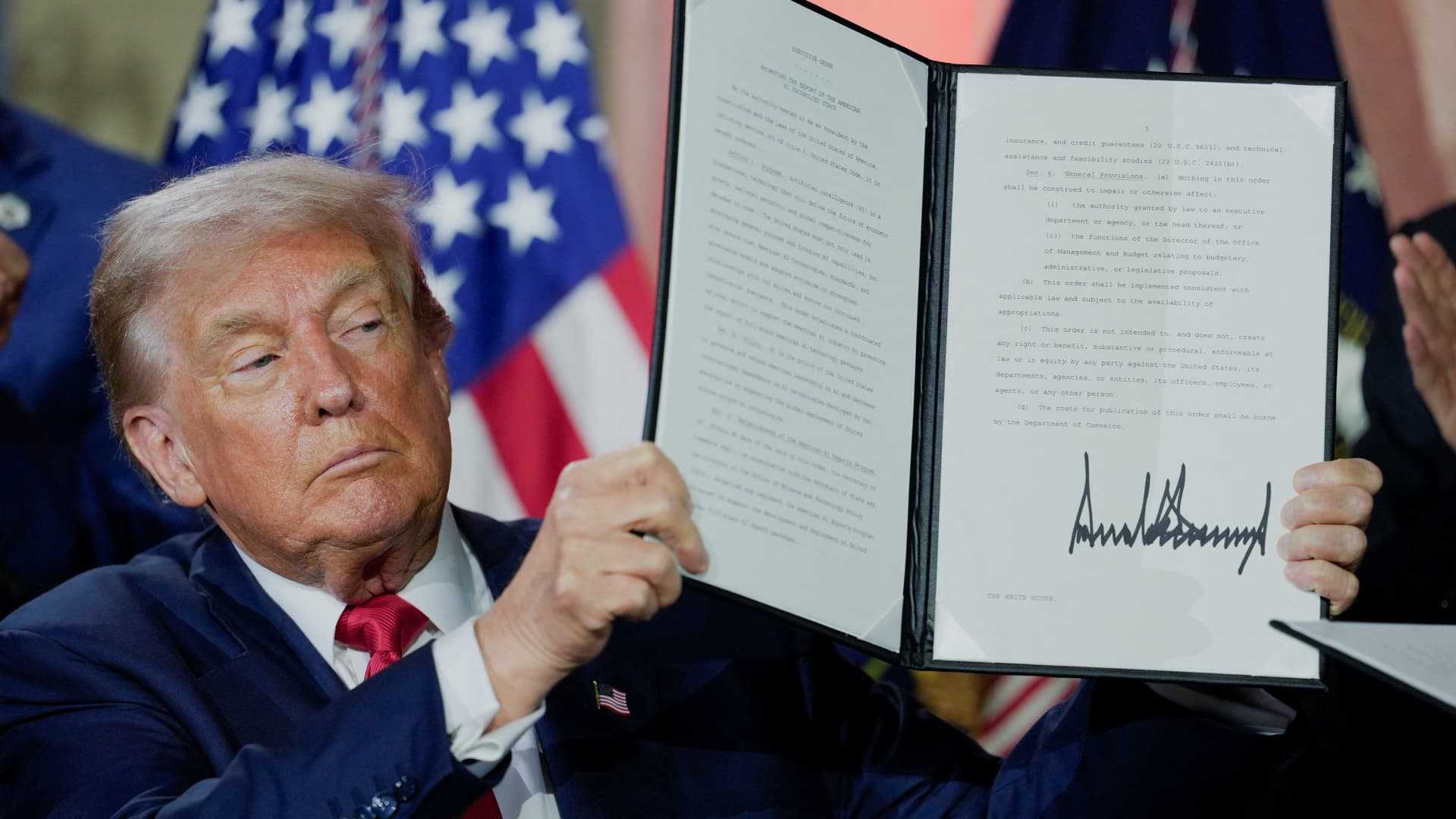
The timing is notable because the administration has been building out a more direct federal role in AI oversight. President Donald Trump signed an AI executive order in June that asks developers to voluntarily share models with the government so officials can assess their capabilities before full release, CNBC reported. The order also gave federal agencies 60 days to create an evaluation framework, meaning a plan for how models would be reviewed.
That process has already affected major AI companies. OpenAI said in June that it agreed to limit the release of its GPT-5.6 model series to a set of “trusted partners” at the request of the U.S. government, according to CNBC. Anthropic disabled access to its Fable 5 and Mythos 5 models two weeks earlier to comply with an export control directive from the Commerce Department, CNBC reported. An export control is a government rule that restricts access to certain technology, often for national security reasons.
Both companies later released their models more broadly, according to CNBC. Still, the episode showed how federal review can affect product timing in a sector where speed matters for customer adoption, cloud demand and competitive positioning.
The White House has also announced a clearinghouse called “Gold Eagle,” which is designed to identify and address cybersecurity vulnerabilities. CNBC previously reported that the program puts the White House in charge of approving which companies can access advanced AI models. A White House release said the clearinghouse has begun to “intake and prioritize identified cybersecurity vulnerabilities” and “coordinate scanning verifications.” CAISI was not listed as one of the agencies involved in developing it.
The leadership change also comes as Chinese open-source models gain attention in the U.S. Open-source models are AI systems whose underlying code or model components are made more broadly available than closed proprietary systems. Chinese startup Moonshot AI introduced Kimi K3 late last week and said the model narrows the gap with leading U.S. offerings and beats the most capable systems from OpenAI and Anthropic on some benchmarks, CNBC reported.
This story draws on original reporting from CNBC.