EU US wellbeing study shows Europe outpacing America on broader metrics
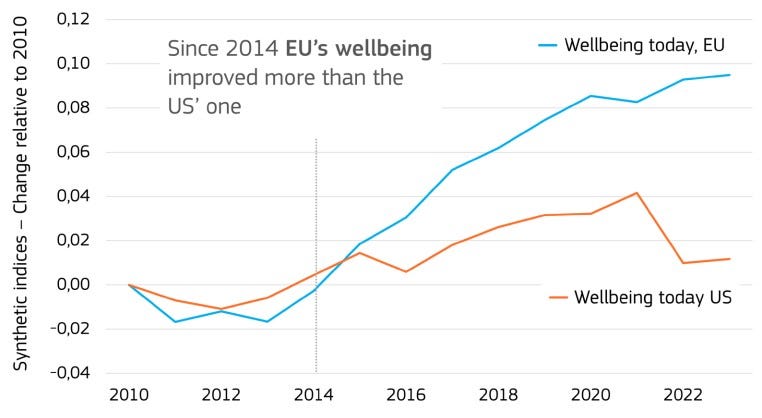
A European Commission study found EU wellbeing rose 9.5% from 2014 to 2025, compared with 1.2% in the US.
By Priya Nair · Economy Reporter
· 3 min read
A new EU US wellbeing study from the European Commission says Europe has pulled ahead of the US on a broader measure of living standards since 2014. For everyday investors, the finding is a useful reminder that GDP, the headline number often used to compare economies, does not capture everything that shapes household life and long-term economic resilience.
The study, cited as Benczur et al. (2026), compared the European Union and the United States using measures that go beyond output and productivity. GDP per capita means economic output divided by population, and it is often used as a rough scorecard for prosperity. The Commission’s work instead included household and social indicators such as real disposable income, housing affordability, employment, access to healthcare, pollution and self-reported life satisfaction.
On that broader wellbeing gauge, the EU rose 9.5% between 2014 and 2025, according to the European Commission study. The US increased 1.2% over the same period.
What did the EU US wellbeing study measure?
The European Commission examined living standards using more than income alone. Its wellbeing measure included economic factors, such as real disposable income and employment rates, as well as social and environmental factors, including healthcare access, pollution and people’s reported satisfaction with their lives.
That approach is meant to catch trade-offs that a single GDP figure can miss. A country can have high output per person while households face expensive housing, limited access to services or lower reported life satisfaction. The Commission’s comparison treats those conditions as part of living standards, rather than side issues.
The study then expanded the framework further to create what it called a sustainable and inclusive wellbeing indicator. That version used 42 indicators, according to the European Commission, including measures tied to future resources, economic resilience, inequality and the quality of institutions.
On that wider index, the EU increased 4% since 2010, while the US fell 0.5%, according to Benczur et al. (2026).
How this fits the US versus Europe living-standards debate
The figures land in an active argument over whether Europe has fallen behind America. Economist Paul Krugman argued during the spring that US living standards are not necessarily better than Europe’s and that Europe has not slipped behind over the past decade or two in living-standard terms.
That argument challenges a common shortcut in market commentary: comparing regions using GDP per capita expressed in US dollars. Critics of that shortcut say currency effects and narrow output measures can make a country look richer without showing whether households have affordable homes, reliable healthcare or cleaner surroundings.
The European Commission’s study does not erase the importance of growth or productivity. Investors still watch those figures because they affect corporate profits, government budgets and market expectations. But the study adds a broader scoreboard for comparing economies, one that puts household conditions and institutional strength alongside income.
The result is a less tidy picture than the usual US-versus-Europe GDP comparison. By the Commission’s broader wellbeing measures, Europe improved more than the US in the periods studied, even though traditional economic rankings often focus on America’s higher dollar-denominated output per person.
This story draws on original reporting from Klement on Investing.