Porterhouse momentum strategy gets rules-based defense from Ben Carlson
Ben Carlson says Ritholtz’s Porterhouse strategy uses preset momentum rules and is meant for only part of a portfolio, not every client.
By Sofia Marchetti · Columnist
· 3 min read
Ritholtz Wealth Management’s Ben Carlson said the Porterhouse momentum strategy is built as a rules-based outlet for a limited slice of an investor’s portfolio, responding to a reader’s concern that active stock selection appears to clash with the idea that beating the market over short periods is hard. For retail investors, the issue is practical: an active sleeve can add complexity, but Carlson argues that preset rules can reduce the emotional mistakes that often come with individual stock picking.
Carlson framed momentum as a strategy based on buying securities that have already shown strong relative performance. A factor strategy uses a defined trait, such as momentum, value or quality, to decide what belongs in a portfolio.
What is the Porterhouse momentum strategy?
Carlson described Porterhouse as a concentrated momentum factor strategy, meaning it uses a set process to own stocks with strong price trends rather than relying on day-to-day judgment. He said Ritholtz worked with the research team at O’Shaughnessy Asset Management to turn Josh Brown’s CNBC stock list into a portfolio with formal buy and sell rules.
The selling rules matter because fast-moving stocks can make investors second-guess themselves. Carlson said many clients arrive with individual stock portfolios that have performed well, but they often struggle with when to sell, whether because they fear exiting too early or waiting too long to diversify.
Carlson said momentum has a behavioral foundation. He cited Eugene Fama, the economist associated with efficient market theory, who has described momentum as a leading market anomaly: stocks with poor recent returns have tended to keep lagging for a time, while stocks with strong recent returns have tended to keep performing well over the next few months.
How does Carlson say momentum fits with passive investing?
Carlson argued that a limited active allocation can coexist with a broader long-term plan. He said a small “fun” portion of a portfolio, sized around 5% to 10%, can help some investors leave the remaining 90% to 95% in a more hands-off strategy.
He used his own account as an example. Carlson said he used to keep about 10% of his portfolio in a brokerage account for individual stock trading, but that small segment consumed most of his attention because he checked it constantly. He said he has put roughly 10% of his portfolio into Porterhouse, calling it the aggressive part of his plan.
Carlson also emphasized that the strategy can be volatile. He pointed to the iShares Momentum ETF in 2026, saying it was down almost 7% at one point, later showed a year-to-date gain near 40%, then suffered a quick drawdown of nearly 20%. He said momentum was up about 20% for the year at the time of his discussion.
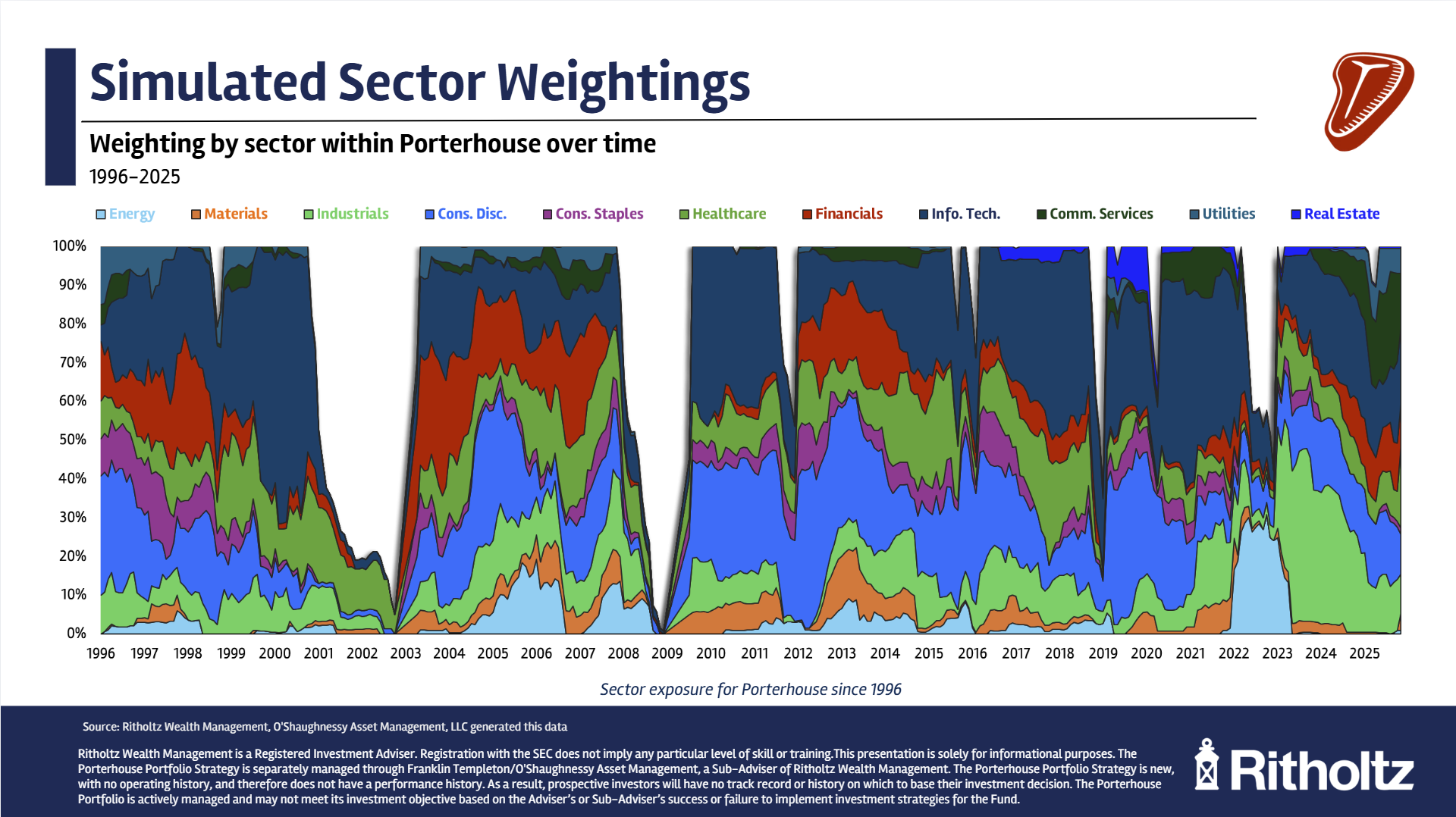
Momentum’s sector mix can also change as market leadership shifts, Carlson said. He described the strategy as one that may complement value or quality stocks because it can hold different types of companies depending on which areas are leading.
Carlson did not present Porterhouse as guaranteed to outperform. He said no strategy carries that guarantee, and Ritholtz is not placing every client into Porterhouse because some clients do not want or need it.
This story draws on original reporting from A Wealth of Common Sense.