CNBC poll finds socialist label polling ahead of MAGA brand
Registered voters were less negative toward democratic socialists than MAGA-aligned candidates in CNBC’s latest All-America Economic Survey.
By Maya Okafor · Markets Writer
· 4 min read
Democratic socialist candidates are testing better with registered voters than Trump-endorsed or MAGA-aligned candidates, according to CNBC’s latest All-America Economic Survey. For retail investors, the takeaway is political risk: election results can shape tax policy, health care spending, labor rules and the odds that Congress slows or advances a president’s agenda.
The CNBC survey, released Friday, found that 32% of registered voters said a candidate calling themselves a Democratic socialist would make them more likely to vote for that person. Half said the label would make them less likely to do so.
That is still a net negative. But CNBC found the MAGA brand tested worse. Twenty-nine percent said an endorsement from President Donald Trump would make them more likely to vote for a candidate, while 52% said it would make them less likely. A self-described supporter of the MAGA movement drew 27% more-likely support and 57% less-likely opposition.
CNBC’s poll was conducted July 8 through July 12 among 1,000 registered U.S. voters. The survey was run with Hart Research Associates and Public Opinion Strategies and has a margin of error of plus or minus 3.1 percentage points.
Why the labels matter
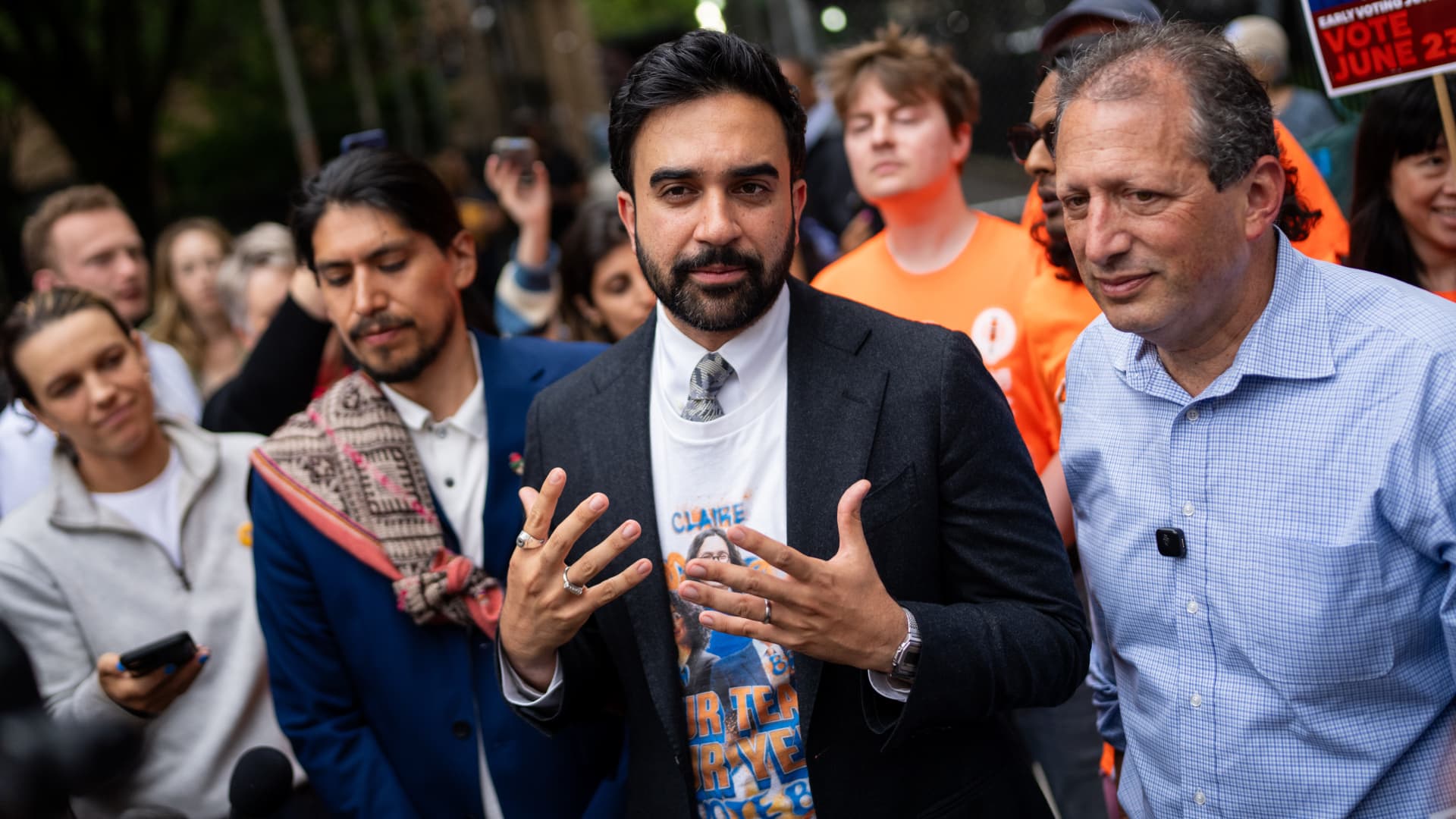
The findings land as self-described democratic socialists have been winning Democratic primaries around the country after the November election of New York City Mayor Zohran Mamdani, CNBC reported. Republicans have responded by trying to tie Democrats broadly to communism, according to CNBC.
Several democratic socialist candidates on ballots this year are calling for higher taxes on the wealthiest Americans to pay for policies such as universal health care, a higher minimum wage and universal basic income, CNBC reported. Universal basic income means recurring cash payments from the government to individuals.
Those ideas would not be expected to become law right away, according to CNBC, because Republicans control the White House through 2028. The more immediate effect could be a tougher relationship between Congress and the executive branch, with Congress potentially slowing parts of Trump’s agenda. CNBC also framed the races as a preview of how Democrats could govern if they win the White House in 2028.
The broader midterm picture in the CNBC poll also favored Democrats. On the generic ballot, which asks voters which party they want to control Congress rather than naming specific candidates, 49% preferred Democratic control and 45% preferred Republican control.
Trump’s approval remains weak in the poll
CNBC’s survey put Trump’s overall approval rating at 40%, with 59% disapproving. On the economy, 38% approved and 60% disapproved. CNBC said both readings were one point worse than its April survey, a shift within the poll’s margin of error but in line with other recent polling on Trump’s standing.
The economy number is especially relevant for markets because presidents often get credit or blame from voters for inflation, jobs, wages and growth, even when those outcomes also depend on the Federal Reserve, Congress and global events.
Capitalism still leads socialism, but the gap has narrowed
CNBC found that capitalism remains viewed more favorably than socialism among registered voters. Fifty percent viewed capitalism positively, compared with 51% in 2024. Socialism’s positive rating rose to 28%, up from 18% in 2024.
Negative views were also split: 48% viewed socialism negatively, while 27% viewed capitalism negatively, according to CNBC.
Younger voters stood apart. Voters ages 18 to 34 preferred socialism over capitalism by 18 percentage points, while older groups favored capitalism, CNBC found. Micah Roberts, a partner at Public Opinion Strategies, the Republican pollster for the survey, told CNBC that if younger and middle-aged voters keep those views over time, the country could see a major change in the policy debate in Congress and elsewhere.
Asked whether some form of socialism would be good or bad for the country, voters were closely divided. CNBC reported that 44% called it a bad thing and 40% called it a good thing, cutting the gap in half from the last time the question was asked. CNBC also cited Gallup results showing that in 2019, 43% of adults viewed socialism as good and 51% viewed it as bad. In 1942, CNBC reported, 25% viewed socialism as a good idea, 40% viewed it as bad and 34% were undecided.
This story draws on original reporting from CNBC.