Euro-area consumers remain cautious about stock investing, survey finds
Only 35% of euro-area consumers held equities in late 2024, while survey evidence points to different barriers across income groups.
By Priya Nair · Economy Reporter
· 3 min read
Euro-area stock investing remains far from universal: 35% of consumers held equities in December 2024, either directly or through mutual funds and exchange-traded funds, according to a 2026 SUERF policy brief drawing on the European Central Bank’s Consumer Expectations Survey. For individual investors, the figure is a reminder that easy access through apps has not erased concerns about risk, money and trust.
The evidence supports a narrower claim than “Europeans do not like stocks.” It covers euro-area consumers, rather than every country in Europe, and measures current ownership. The survey found that another 12% had owned equity investments previously but held none at the time of the survey, the brief said.
An equity investment is an ownership stake in a company, held either by buying shares directly or through a pooled product such as a mutual fund or exchange-traded fund. ETFs hold baskets of assets and trade on an exchange like individual shares.
Why do euro-area consumers avoid stock investing?
The answers differ by household income, according to the SUERF brief. Lower-income people who did not invest most often identified a lack of financial resources as their main obstacle. Higher-income non-investors more often pointed to financial risk and limited trust in markets.
Ownership also varied sharply by personal characteristics. Younger, male, more educated, more financially literate and more trusting consumers were more likely to hold equities, the authors found. Those patterns describe associations in the survey; they do not establish that any single trait causes someone to invest.
Access alone does not appear to settle the question. The brief said 77% of euro-area consumers used mobile apps for online banking, and more than half of investors used a website or phone app to make trades. Still, only 16% of people who had never invested said at the end of 2024 that they planned to enter the stock market over the next 12 months. That compared with 54% of current or former investors and 29% across all consumers.
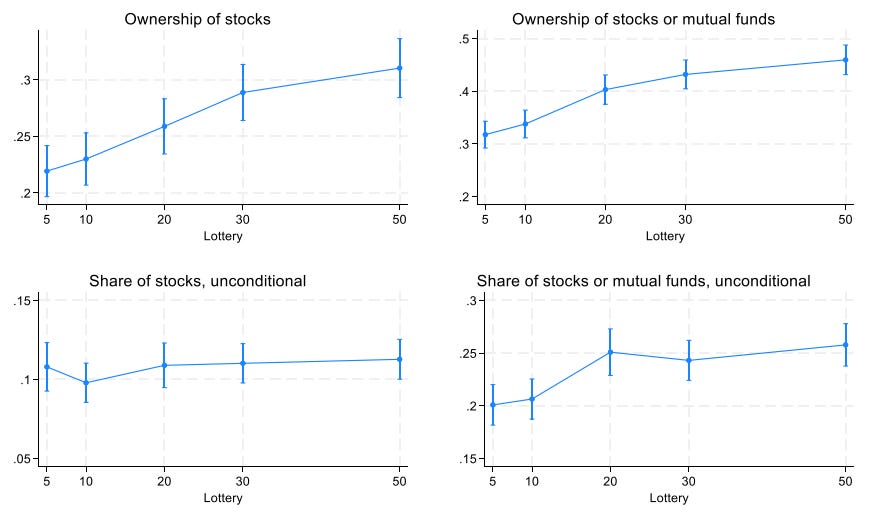
A separate analysis of the survey’s hypothetical lottery questions reached a similar conclusion. Klement on Investing, summarizing research by Christelis and co-authors, reported that a €50,000 windfall would increase participation among people who did not already own stocks by 8.4 to 12.8 percentage points. More than 60% of households would still put nothing into stocks, according to the analysis.
The comparison with the United States needs care. The SUERF brief cited a Gallup figure of 62% for U.S. consumers under a broader ownership definition that includes direct stocks, mutual funds and private pension plans. The material available does not show that the U.S. and euro-area surveys use identical questions or definitions, so the numbers are not a like-for-like scorecard.
EFAMA, the European fund-management trade group, argues that perceived complexity, risk aversion and limited financial literacy discourage participation, and has called for simpler rules, pension policies and tax incentives. That is an industry-policy view, rather than a settled explanation of why every household stays out of the market.
This story draws on original reporting from Klement on Investing.