Warsh holds Fed rates steady as markets weigh possible hike
The Fed kept rates at 3.5% to 3.75%, but new projections and Warsh’s tone left investors bracing for a less predictable central bank.
By Sofia Marchetti · Columnist
· 3 min read
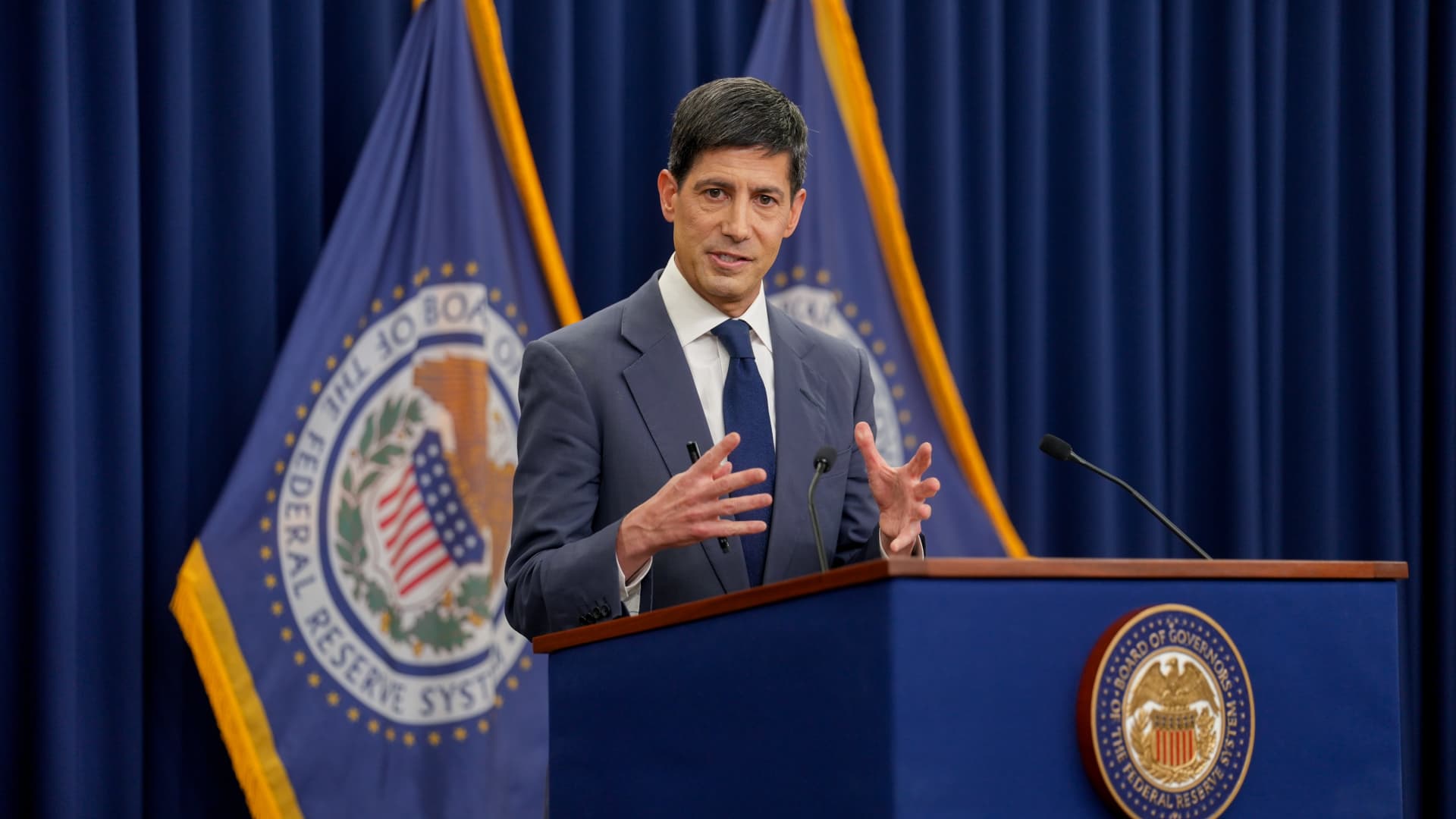
The Federal Reserve kept its benchmark interest rate unchanged Wednesday in Kevin Warsh’s first meeting as chair, but the message around future policy shifted enough to unsettle markets. For everyday investors, the key point is that the Fed did not raise borrowing costs today, while its own projections suggested a rate increase could still arrive later this year.
The Federal Open Market Committee voted to hold the federal funds rate in a target range of 3.5% to 3.75%, according to CNBC. That rate is the overnight lending rate banks charge each other, and it ripples through credit cards, mortgages, auto loans, savings yields and stock valuations.
Stocks fell after the decision and during Warsh’s press conference, CNBC reported. The policy-sensitive 2-year Treasury yield rose 14.4 basis points, with one basis point equal to 0.01 percentage point. A rising 2-year yield often signals that bond investors expect tighter Fed policy than they did before.
Rate projections pointed to a split Fed
The Fed’s closely watched “dot plot” showed officials divided over where rates should go next. The dot plot is a chart of individual policymakers’ expectations for interest rates, with each dot representing one official’s view.
CNBC reported that the committee was split 9-9 between officials expecting either steady rates or one cut and officials expecting at least one increase. The median dot pointed to a quarter-point rate hike later this year.
Warsh confirmed that he did not submit a projection of his own. He said he had encouraged other committee participants to keep submitting projections, while he “refrained from offering any projections” consistent with his long-held views on the Summary of Economic Projections, the Fed’s formal quarterly outlook.
That choice matters because investors use the chair’s signals to interpret where policy may be headed. Dario Perkins, managing director of global macro at TS Lombard, said Warsh appeared to want his first impression to be as “the reformer” and added that “Fed watching just got harder.”
Warsh starts review of Fed practices
Warsh also announced five task forces, according to CNBC, signaling that he wants to examine how the central bank works. The groups will study Fed communications, the balance sheet, the data the Fed relies on, productivity and jobs, artificial intelligence and other transformative technologies, and the central bank’s approach to inflation.
Jason Pride, chief of investment strategy at Glenmede, said the task force announcements suggest “an institution in active review rather than steady state.” He said investors should expect the Fed’s operating framework to look meaningfully different during Warsh’s tenure than it did under his predecessor.
Warsh repeatedly emphasized “price stability,” CNBC reported, using the phrase about a dozen times. Price stability is the Fed’s goal of keeping inflation under control so money holds its purchasing power over time.
Krishna Guha, head of central bank strategy and economics at Evercore ISI, said Warsh sounded like his earlier, more inflation-focused self as a Fed governor by repeating the need to deliver on that mandate.
The Fed also changed how it talked to the public. Its post-meeting statement was 130 words, CNBC reported, compared with statements that had generally run above 300 words before Warsh became chair. Rick Rieder, head of fixed income at BlackRock, said the meeting “ushered in a new era of monetary policy in the United States.”
This story draws on original reporting from CNBC.