5x margin investing shows why staying power matters more than a big bet
A 5x margin position can lose all of its equity after a 20% asset drop, with broker rules potentially forcing sales earlier.
By Priya Nair · Economy Reporter
· 3 min read
5x margin investing can turn a manageable decline into a permanent loss of capital. The central issue for everyday investors is not only whether an investment eventually recovers, but whether borrowed money leaves them able to hold it through the decline.
Margin is borrowing from a broker to buy a larger position than an investor could fund with cash alone. It magnifies gains when prices rise, but it magnifies losses by the same mechanism when prices fall.
Consider a $5 stock position funded with $1 of an investor’s money and $4 borrowed, which is 5x leverage. If the holdings fall 10%, the position drops to $4.50. After repaying the $4 debt, $0.50 remains, meaning the investor’s equity has fallen 50%. A 20% decline leaves a $4 position, equal to the debt, erasing the original $1 of equity.
Those calculations do not mean a broker will wait for a 20% loss. Brokers impose maintenance-margin requirements, which set a minimum amount of investor equity required in an account. If an account falls below that threshold, the investor may have to add cash or sell assets. The precise threshold varies by broker and is not established here.
Why can 5x margin investing force a sale before a stock recovers?
A portfolio loss is a decline in the value of holdings that an investor can continue to own. A forced sale occurs when a broker’s margin rules require more collateral or liquidation. That distinction is vital for a long-term thesis: an investor may be right about an asset’s eventual recovery but still lose the chance to participate if the account cannot absorb the interim drop.
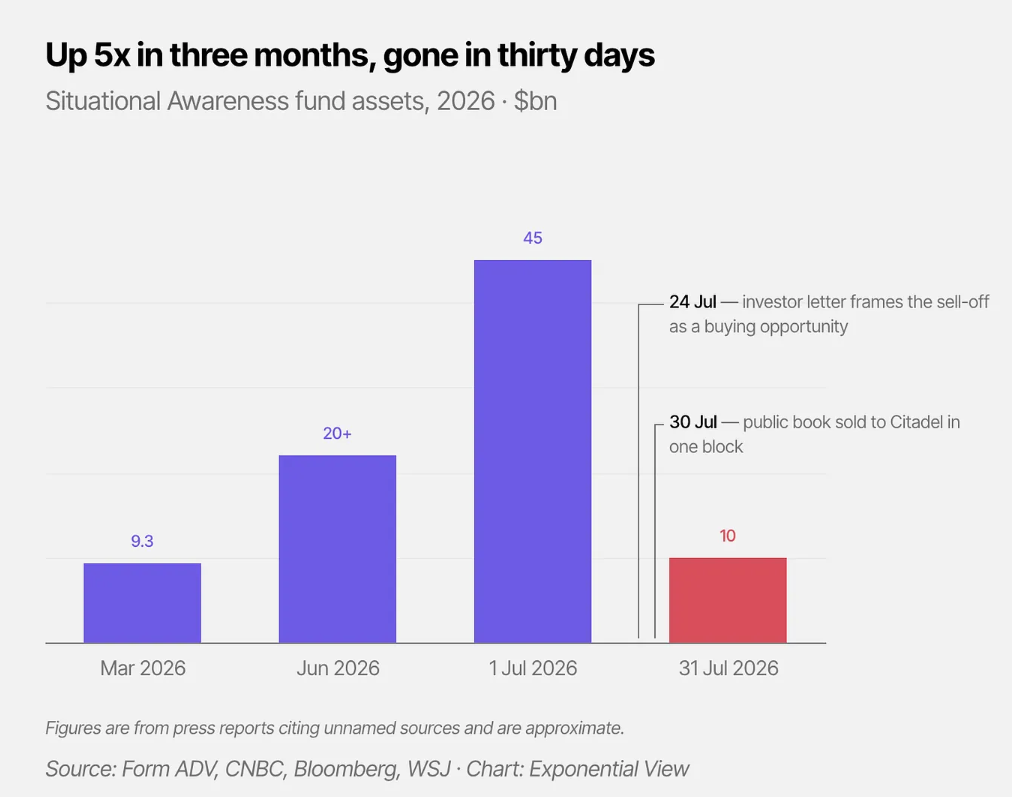
A Wealth of Common Sense used the recent stress at Leopold Aschenbrenner’s Situational Awareness fund as an illustration. Citing a Wall Street Journal account based on people familiar with the matter, the publication said the AI-focused fund borrowed roughly $3 to $4 or more for each $1 of capital and also used options to amplify returns.
The publication reported that declines of about 30% to 60% in AI-related stocks contributed to a sale of assets to Citadel at a 10% discount. Those details are an attributed account, not independently established by the material reviewed here. The broader lesson offered by the publication is that leverage can make an investor a seller during volatility even when the underlying holdings retain a longer-term case.
What does an investment-survival approach mean?
It is an investing philosophy centered on avoiding losses or liquidity events that prevent an investor from remaining invested. It does not guarantee returns or establish that leverage is unsuitable for any particular person.
Peter Bernstein’s views, reproduced by Safal Niveshak, frame risk management as necessary because investors cannot know the future with certainty. The material describes diversification, spreading money across holdings rather than concentrating it in one bet, as a way to recognize that uncertainty and preserve exposure to unexpected winners.
- Leverage reduces the size of a decline an account can withstand.
- Concentration can compound that pressure when several holdings fall together.
- Maintenance-margin rules can cause action before an investor’s equity reaches zero.
- Diversification and lower borrowing are risk-management tools, not promises of protection from losses.
The evidence does not provide a full comparison of leveraged strategies or individualized guidance. It does show the basic arithmetic behind the survival argument: keeping enough equity and flexibility to avoid becoming a forced seller can matter as much as identifying an investment with upside.
This story draws on original reporting from A Wealth of Common Sense.